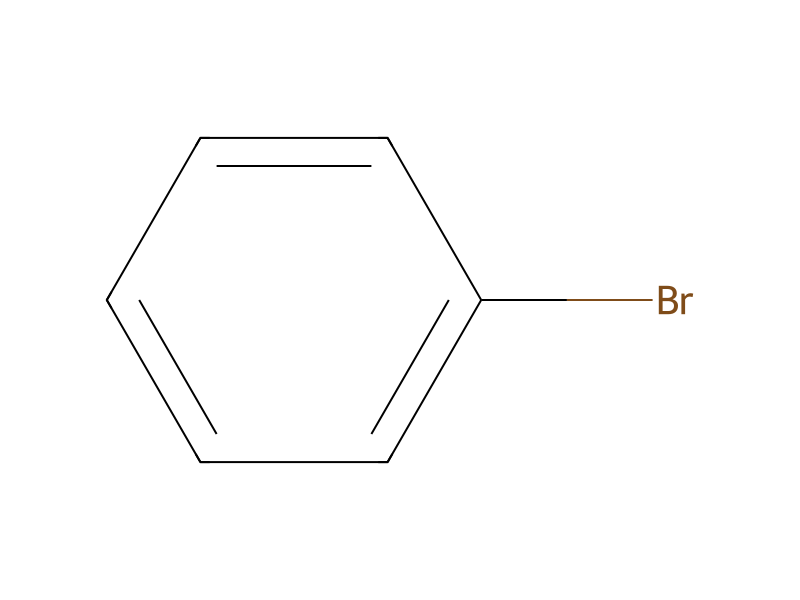
Bromobenzene → 2-Phenylthiophene
Reaction equation

[S:1]1[CH:5]=[CH:4][CH:3]=[CH:2]1.C([Li])CCC.Br[C:12]1[CH:17]=[CH:16][CH:15]=[CH:14][CH:13]=1>O1CCCC1.[Cl-].[Zn+2].[Cl-]>[C:12]1([C:2]2[S:1][CH:5]=[CH:4][CH:3]=2)[CH:17]=[CH:16][CH:15]=[CH:14][CH:13]=1Participants
Reactant 3


Product 1

Reagents, catalysts & solvents 2


Procedure
To a solution of thiophene (9.5 mL, 0.12 mole) in 100 mL tetrahydrofuran at 0° C. was added 2M n-butyllithium (48 mL, 0.12 mole) dropwise. The solution was stirred 2.5 h and was then added via cannula to a stirred solution of anhydrous zinc chloride (26 g, 0.19 mole) in 100 mL of THF at room temperature. After 1 h this solution was transferred via cannula into a solution of bromobenzene (8.4 mL, 0.08 mole) and tetrakis-triphenylphosphine palladium (0.2 g) in 100 mL of THF. The solution was warmed to reflux overnight. The solution was cooled to room temperature and quenched with saturated ammonium chloride solution. The mixture was extracted with ether (3×50 mL). The ether extracts were washed with brine, dried (MgSO4), filtered and concentrated. The material was distilled (20 mm Hg) to yield 7.5 g (60%) of desired product, b.p.=150° C.
Workup
- temperatureThe solution was warmed
- temperatureto reflux overnight
- customquenched with saturated ammonium chloride solution
- extractionThe mixture was extracted with ether (3×50 mL)
- washThe ether extracts were washed with brine
- dry with materialdried (MgSO4)
- filtrationfiltered
- concentrationconcentrated
- distillationThe material was distilled (20 mm Hg)
Sources & evidence
- ORD record
- ord-510832e5873f4f4aabf1cf963f92d876
- Source dataset
- uspto-grants-1993_02
- Patent number
- US05185363
Reaction notes
Loading…