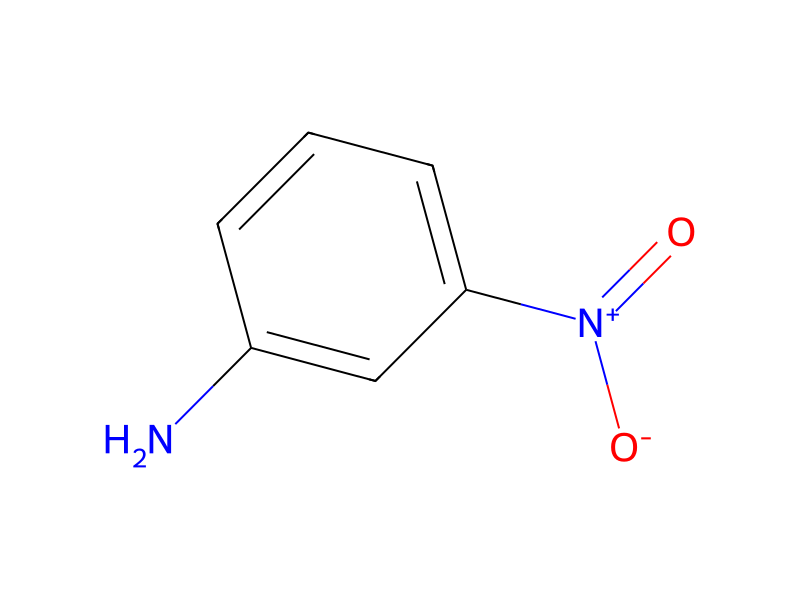
3-Nitroaniline → N-(3-nitrophenyl)-2-naphthalenecarboxamide
Reaction equation

[N+:1]([C:4]1[CH:5]=[C:6]([CH:8]=[CH:9][CH:10]=1)[NH2:7])([O-:3])=[O:2].C(N(CC)CC)C.[CH:18]1[C:27]2[C:22](=[CH:23][CH:24]=[CH:25][CH:26]=2)[CH:21]=[CH:20][C:19]=1[C:28](Cl)=[O:29].C(=O)(O)[O-].[Na+]>O1CCOCC1>[N+:1]([C:4]1[CH:5]=[C:6]([NH:7][C:28]([C:19]2[CH:20]=[CH:21][C:22]3[C:27](=[CH:26][CH:25]=[CH:24][CH:23]=3)[CH:18]=2)=[O:29])[CH:8]=[CH:9][CH:10]=1)([O-:3])=[O:2]Participants
6
Reactant 4



Product 1

Reagents, catalysts & solvents 1

Procedure
To a mixture of 3-nitroaniline (2.07 g) and triethylamine (2.3 ml) in 1,4-dioxane (40 ml) was added 2-naphthoyl chloride (3.00 g) and the mixture was stirred at room temperature for 30 minutes. Then the mixture was poured into aqueous sodium bicarbonate and extracted with ethyl acetate three times. The combined organic phase was washed with aqueous sodium bicarbonate and brine, dried over magnesium sulfate and concentrated. The resultant solid was collected and washed with isopropyl ether to give N-(3-nitrophenyl)-2-naphthalenecarboxamide (3.02 g).
Workup
- extractionextracted with ethyl acetate three times
- washThe combined organic phase was washed with aqueous sodium bicarbonate and brine
- dry with materialdried over magnesium sulfate
- concentrationconcentrated
- customThe resultant solid was collected
- washwashed with isopropyl ether
Sources & evidence
- ORD record
- ord-0d6ed5d837924bc8a398f2c0f958200e
- Source dataset
- uspto-grants-2004_04
- Patent number
- US06727245B2
Reaction notes
Loading…