Water → 7-Cyano-1,2,3,4-tetrahydro-naphthalen-1-ol
Reaction equation

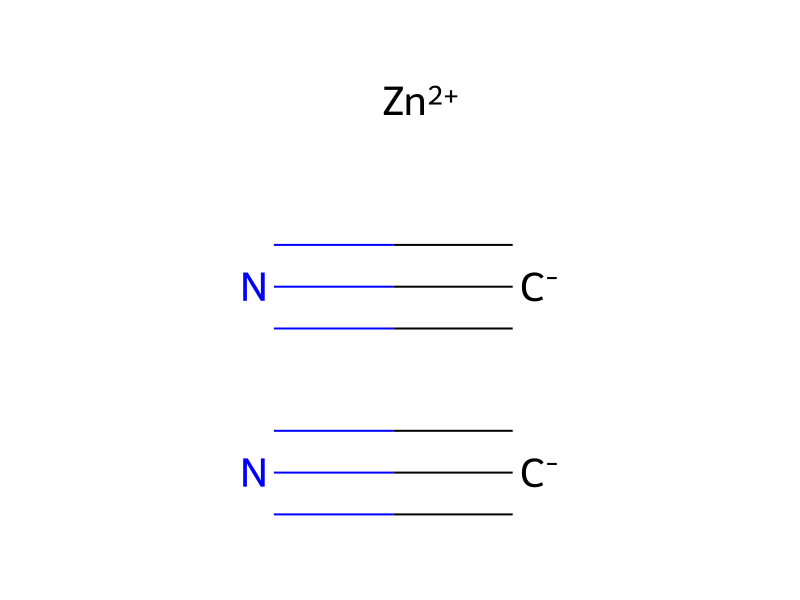
Br[C:2]1[CH:11]=[C:10]2[C:5]([CH2:6][CH2:7][CH2:8][CH:9]2[OH:12])=[CH:4][CH:3]=1.O.C(OCC)C.[CH3:19][N:20](C=O)C>[C-]#N.[Zn+2].[C-]#N.[Pd].C1(P(C2C=CC=CC=2)C2C=CC=CC=2)C=CC=CC=1.C1(P(C2C=CC=CC=2)C2C=CC=CC=2)C=CC=CC=1.C1(P(C2C=CC=CC=2)C2C=CC=CC=2)C=CC=CC=1.C1(P(C2C=CC=CC=2)C2C=CC=CC=2)C=CC=CC=1>[C:19]([C:2]1[CH:11]=[C:10]2[C:5]([CH2:6][CH2:7][CH2:8][CH:9]2[OH:12])=[CH:4][CH:3]=1)#[N:20]Participants
Reactant 4




Product 1

Reagents, catalysts & solvents 2

Conditions
- Temperature
- 95 °C
Procedure
To a solution of 7-bromo-1,2,3,4-tetrahydro-naphthalen-1-ol (0.708 g, 3.11 mmol), which can be prepared as described in Example 5, in DMF (6.5 mL) is added zinc cyanide (0.274 g, 2.33 mmol). Four evacuation-nitrogen fill cycles are performed and tetrakis(triphenylphosphine) palladium (0.072 g, 0.062 mmol) is added. The mixture is heated to 95° C. until the reaction is complete, whereupon water and diethyl ether are added. The mixture is filtered through Celite® and the organic phase is washed with water, dried with MgSO4, filtered and concentrated to give 7-cyano-1,2,3,4-tetrahydro-naphthalen-1-ol; 1H NMR (400 MHz, CDCl3) δ ppm 1.76-1.92 (m, 2 H), 1.95-2.13 (m, 2 H), 2.73-2.94 (m, 2 H), 4.77-4.80 (m, 1 H), 7.20 (d, J=8.0 Hz, 1 H), 7.46 (dd, J=8.0, 1.6 Hz, 1 H), 7.79 (br. s, 1 H).
Workup
- additionare added
- filtrationThe mixture is filtered through Celite®
- washthe organic phase is washed with water
- dry with materialdried with MgSO4
- filtrationfiltered
- concentrationconcentrated
Sources & evidence
- ORD record
- ord-4cf5a92626824bb48a354dfda6cb2de8
- Source dataset
- uspto-grants-2013_05
- Patent number
- US08436035B2
Reaction notes
Loading…