Sodium Bromide → HCID 59199432, compound
Reaction equation

[CH:1]([O:4][C:5]([C:7]1[N:8]([CH:12]2[C:21]3[C:16](=[CH:17][C:18](OS(C(F)(F)F)(=O)=O)=[CH:19][CH:20]=3)[CH2:15][CH2:14][CH2:13]2)[CH:9]=[N:10][CH:11]=1)=[O:6])([CH3:3])[CH3:2].[CH:30]1(B(O)O)[CH2:32][CH2:31]1.[F-].[K+].[Br-].[Na+]>O.[Pd].C1(P(C2C=CC=CC=2)C2C=CC=CC=2)C=CC=CC=1.C1(P(C2C=CC=CC=2)C2C=CC=CC=2)C=CC=CC=1.C1(P(C2C=CC=CC=2)C2C=CC=CC=2)C=CC=CC=1.C1(P(C2C=CC=CC=2)C2C=CC=CC=2)C=CC=CC=1.C1(C)C=CC=CC=1>[CH:1]([O:4][C:5]([C:7]1[N:8]([CH:12]2[C:21]3[C:16](=[CH:17][C:18]([CH:30]4[CH2:32][CH2:31]4)=[CH:19][CH:20]=3)[CH2:15][CH2:14][CH2:13]2)[CH:9]=[N:10][CH:11]=1)=[O:6])([CH3:3])[CH3:2]Participants
Reactant 4


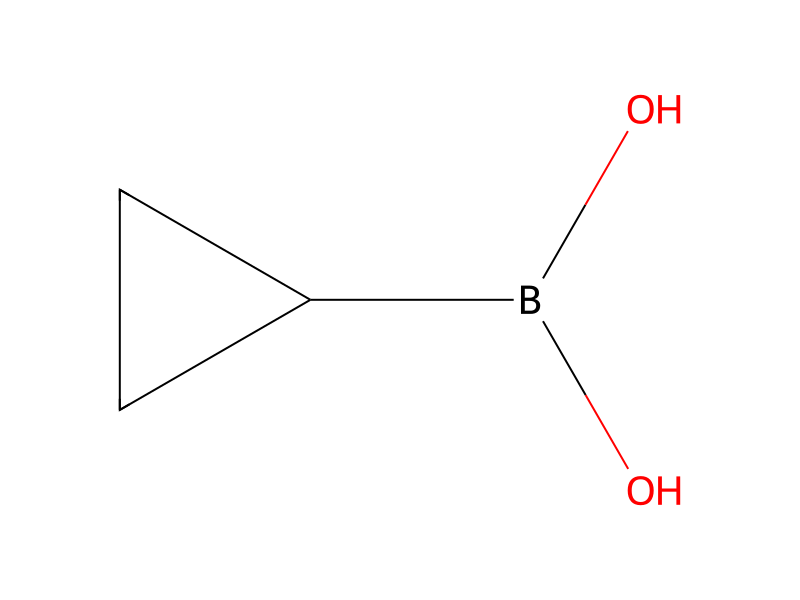

Product 1

Reagents, catalysts & solvents 3



Conditions
- Temperature
- 90 °C
Procedure
A flask is charged with 3-(6-trifluoromethanesulfonyloxy-1,2,3,4-tetrahydro-naphthalen-1-yl)-3H-imidazole-4-carboxylic acid isopropyl ester (0.183 g, 0.426 mmol), which can be prepared as described in Example 48, cyclopropylboronic acid (0.091 g, 1.059 mmol), potassium fluoride (0.081 g, 1.39 mmol), sodium bromide (0.043 g, 0.423 mmol) and toluene (5 mL). Tetrakis(triphenylphosphine) palladium (0.015 g, 0.013 mmol) is added and the mixture is heated to 90° C. overnight. The reaction is cooled to room temperature, diluted with water and extracted with dichloromethane. The organic phase is dried over Na2SO4, filtered, and concentrated to give a residue, which is purified by silica gel chromatography (elution with hexanes-ethyl acetate mixtures) to give 3-(6-cyclopropyl-1,2,3,4-tetrahydro-naphthalen-1-yl)-3H-imidazole-4-carboxylic acid isopropyl ester; MS: (ESI) m/z 325.2 (M+H)+. The HCl salt of the title compound can be prepared by dissolution in diethyl ether followed by treatment with an excess of 1N HCl in diethyl ether. The resulting heterogeneous solution is concentrated to furnish the HCl salt of 3-(6-cyclopropyl-1,2,3,4-tetrahydro-naphthalen-1-yl)-3H-imidazole-4-carboxylic acid isopropyl ester; 1H NMR (400 MHz, MeOD) δ ppm 0.71-0.75 (m, 2 H), 1.00-1.05 (m, 2 H), 1.43 (d, J=6.3 Hz, 3 H), 1.46 (d, J=6.3 Hz, 3 H), 1.65-1.76 (m, 1 H), 1.87-1.98 (m, 2 H), 2.24-2.39 (m, 2 H), 2.87 (ddd, J=16.9, 9.3, 5.3 Hz, 1 H), 3.00 (dt, J=16.9, 5.0 Hz, 1 H), 5.34 (sept, J=6.3 Hz, 1 H), 6.51 (t, J=4.8 Hz, 1 H), 6.98 (dd, J=9.3, 1.2 Hz, 1 H), 7.03 (d, J=9.3 Hz, 2 H), 8.32 (d, J=1.5 Hz, 1 H), 8.51 (d, J=1.0 Hz, 1 H).
Workup
- customcan be prepared
- temperatureThe reaction is cooled to room temperature
- extractionextracted with dichloromethane
- dry with materialThe organic phase is dried over Na2SO4
- filtrationfiltered
- concentrationconcentrated
- customto give a residue, which
- customis purified by silica gel chromatography (elution with hexanes-ethyl acetate mixtures)
Sources & evidence
- ORD record
- ord-c772ef42738345d1bec5e9014e6508d0
- Source dataset
- uspto-grants-2013_05
- Patent number
- US08436035B2
Reaction notes
Loading…