Pyridine → methyl 1-phenyl-1H-indazole-3-carboxylate
Reaction equation

[NH:1]1[C:9]2[C:4](=[CH:5][CH:6]=[CH:7][CH:8]=2)[C:3]([C:10]([O:12][CH3:13])=[O:11])=[N:2]1.[C:14]1(B(O)O)[CH:19]=[CH:18][CH:17]=[CH:16][CH:15]=1.N1C=CC=CC=1>C([O-])(=O)C.[Cu+2].C([O-])(=O)C.CN(C)C=O>[C:14]1([N:1]2[C:9]3[C:4](=[CH:5][CH:6]=[CH:7][CH:8]=3)[C:3]([C:10]([O:12][CH3:13])=[O:11])=[N:2]2)[CH:19]=[CH:18][CH:17]=[CH:16][CH:15]=1Participants
6


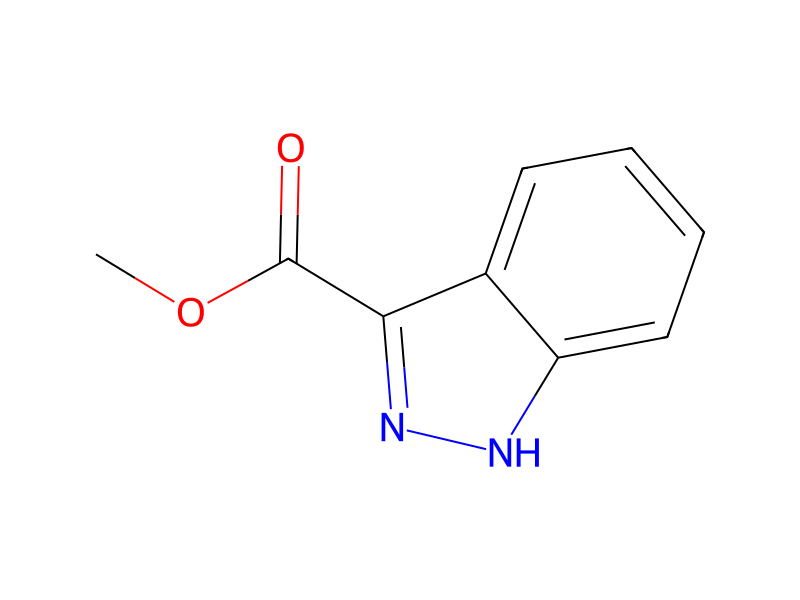



Conditions
- Temperature
- 30 °C
Procedure
To a mixture of methyl 1H-indazole-3-carboxylate (3.44 g), phenylboronic acid (4.76 g), pyridine (2.84 mL) and N,N-dimethylformamide (70 mL) was added copper (II) acetate (5.32 g), and the mixture was stirred at 30° C. overnight. The insoluble material was filtered off, saturated aqueous ammonium chloride solution was added, and the mixture was extracted with ethyl acetate. The extract was washed with saturated sodium hydrogen carbonate and saturated brine, dried over magnesium sulfate, and concentrated under reduced pressure. The residue was purified by silica gel column chromatography (ethyl acetate:hexane=1:4, volume ratio) to give the title object compound (1.58 g, 32%) as a pale-yellow oil.
Workup
- filtrationThe insoluble material was filtered off
- additionsaturated aqueous ammonium chloride solution was added
- extractionthe mixture was extracted with ethyl acetate
- washThe extract was washed with saturated sodium hydrogen carbonate and saturated brine
- dry with materialdried over magnesium sulfate
- concentrationconcentrated under reduced pressure
- customThe residue was purified by silica gel column chromatography (ethyl acetate:hexane=1:4, volume ratio)
Sources & evidence
- ORD record
- ord-20d36dff82c7444e8f19e5d12bb6ec70
- Source dataset
- uspto-grants-2013_05
- Patent number
- US08436043B2
Reaction notes
Loading…