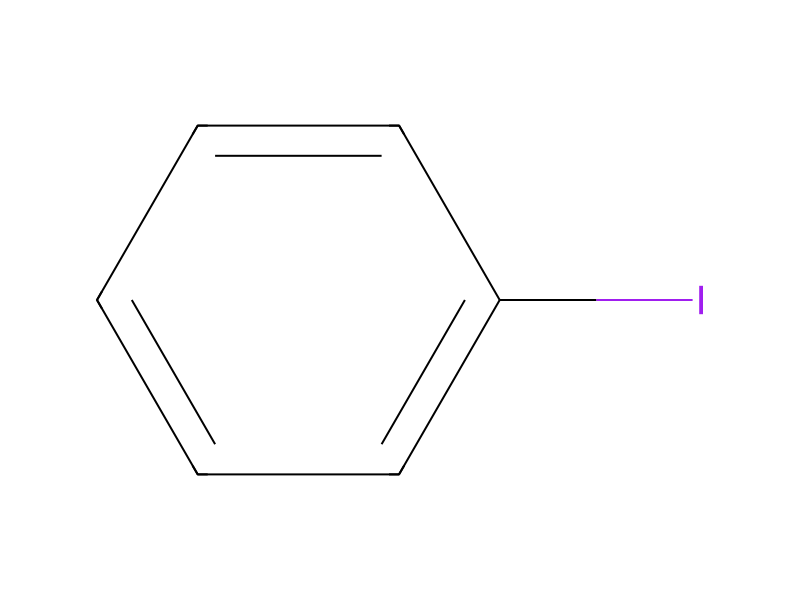
Iodobenzene → 4-Bromo-3-phenylpyridine
Reaction equation

Cl.[Br:2][C:3]1[CH:8]=[CH:7][N:6]=[CH:5][CH:4]=1.[Li+].CC([N-]C(C)C)C.I[C:18]1[CH:23]=[CH:22][CH:21]=[CH:20][CH:19]=1>C1COCC1.[Cl-].[NH4+].[Cl-].[Cl-].[Zn+2].C1C=CC([P]([Pd]([P](C2C=CC=CC=2)(C2C=CC=CC=2)C2C=CC=CC=2)([P](C2C=CC=CC=2)(C2C=CC=CC=2)C2C=CC=CC=2)[P](C2C=CC=CC=2)(C2C=CC=CC=2)C2C=CC=CC=2)(C2C=CC=CC=2)C2C=CC=CC=2)=CC=1>[Br:2][C:3]1[CH:8]=[CH:7][N:6]=[CH:5][C:4]=1[C:18]1[CH:23]=[CH:22][CH:21]=[CH:20][CH:19]=1Participants
Reactant 3


Product 1

Reagents, catalysts & solvents 4




Conditions
- Temperature
- -78 °C
Procedure
4-bromopyridine hydrochloride (1-BA-2, 1 g, 5.14 mmol) was dissolved in 5.1 mL of THF and the resulting solution was cooled to −78° C. LDA (10.28 mL of a 1 M solution in THF) was added over 10 minutes and the reaction mixture became brown. After stirring for 30 minutes, ZnCl2 (10.3 mL of a 0.5 M solution in THF) was added over 10 minutes and the resulting mixture was stirred for 10 minutes and then allowed to warm to rt. Iodobenzene (0.229 mL, 2.06 mmol) and Pd(PPh3)4 (593 mg, 0.514 mmol) were added and the resulting mixture was stirred under reflux for 2 h. The reaction mixture was diluted with aqueous saturated ammonium chloride and extracted with ethyl acetate. The organic phase was dried over Na2SO4 and evaporated. The residue was purified by silica column (hexane:EtOAc) to give 4-bromo-3-phenylpyridine (2-BA-2, 741 mg, 62%); LCMS: 234.0 m/z (M+H)+.
Workup
- stirringthe resulting mixture was stirred for 10 minutes
- temperatureto warm to rt
- stirringthe resulting mixture was stirred
- temperatureunder reflux for 2 h
- extractionextracted with ethyl acetate
- dry with materialThe organic phase was dried over Na2SO4
- customevaporated
- customThe residue was purified by silica column (hexane:EtOAc)
Sources & evidence
- ORD record
- ord-d77f41837dcb4607a31a26e25917d47b
- Source dataset
- uspto-grants-2013_05
- Patent number
- US08445503B2
Reaction notes
Loading…