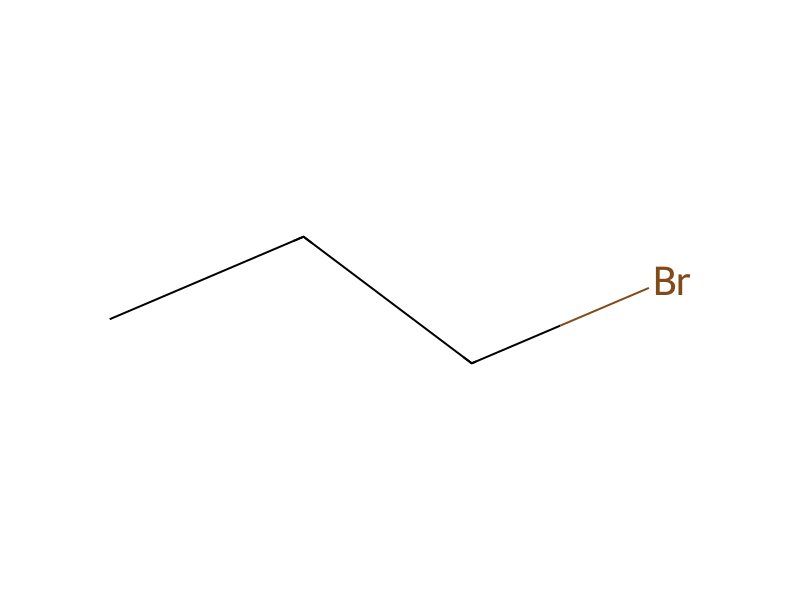
1-Bromopropane → 2-Propoxy-3-trifluoromethoxybenzaldehyde
Reaction equation

[OH:1][C:2]1[C:9]([O:10][C:11]([F:14])([F:13])[F:12])=[CH:8][CH:7]=[CH:6][C:3]=1[CH:4]=[O:5].C([O-])([O-])=O.[K+].[K+].Br[CH2:22][CH2:23][CH3:24]>CN(C=O)C>[CH2:22]([O:1][C:2]1[C:9]([O:10][C:11]([F:12])([F:13])[F:14])=[CH:8][CH:7]=[CH:6][C:3]=1[CH:4]=[O:5])[CH2:23][CH3:24]Participants
5
Reactant 3


Product 1

Reagents, catalysts & solvents 1

Conditions
- Temperature
- 37 °C
Procedure
To a solution of 2-hydroxy-3-trifluoromethoxybenzaldehyde (1.00 g, 4.82 mmol) in DMF (10 mL) was added K2CO3 (1.46 g, 10.6 mmol) followed by 1-bromopropane (0.65 mL, 7.2 mmol). The solution was heated to 37° C. for 6 h. The reaction was quenched with H2O (40 mL) and the mixture was extracted with EtOAc (3×50 mL). The combined organics were washed with brine (2×100 mL), dried (Na2SO4) and concentrated to yield the title compound (1.15 g, 96%) as a yellow oil: 1H NMR (300 MHz, DMSO-d6) δ 10.30 (s, 1H), 7.77 (d, J=8.0 Hz, 2H), 7.38 (t, J=7.9 Hz, 1H), 4.09 (t, J=6.4 Hz, 2H), 1.81-1.72 (m, 2H), 1.01 (t, J=7.4 Hz, 3H).
Workup
- customThe reaction was quenched with H2O (40 mL)
- extractionthe mixture was extracted with EtOAc (3×50 mL)
- washThe combined organics were washed with brine (2×100 mL)
- dry with materialdried (Na2SO4)
- concentrationconcentrated
Sources & evidence
- ORD record
- ord-81e6059df06147de8bc685852582009f
- Source dataset
- uspto-grants-2013_05
- Patent number
- US08450307B2
Reaction notes
Loading…