Water → HCID 57803044, compound
Reaction equation

[Cl:1][C:2]1[CH:10]=[C:9]2[C:5]([CH2:6][C:7](=[O:11])[NH:8]2)=[CH:4][CH:3]=1.[H-].[Li+].Cl[C:15]1[N:20]=[C:19]([O:21][CH3:22])[N:18]=[C:17]([O:23][CH3:24])[CH:16]=1.O>CN(C)C=O>[Cl:1][C:2]1[CH:10]=[C:9]2[C:5]([CH:6]([C:15]3[CH:16]=[C:17]([O:23][CH3:24])[N:18]=[C:19]([O:21][CH3:22])[N:20]=3)[C:7](=[O:11])[NH:8]2)=[CH:4][CH:3]=1Participants
Reactant 4



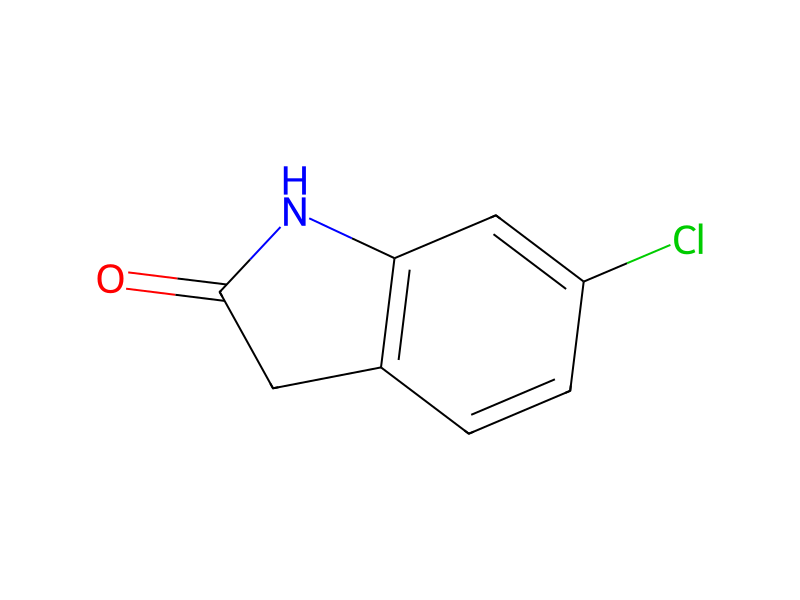
Product 1

Reagents, catalysts & solvents 1

Procedure
To a suspension of 6-chlorooxindole (0.94 g, 5.34 mmol) (Cresent Chem.) in N,N-dimethylformamide (20 mL) at room temperature was added lithium hydride (86 mg, 10.7 mmol) (Aldrich). The mixture was stirred at room temperature for 10 minutes, then 6-chloro-2,4-dimethoxy-pyrimidine (0.93 g, 5.34 mmol) (Aldrich) was added. The reaction mixture was heated at 110° C. for 3 hours. The mixture was cooled to room temperature. Water (100 mL) was added, and mixture was extracted with ethyl acetate (2×100 mL). The organic layers were separated, combined, washed with water, brine, dried over Na2SO4 and concentrated. The residue was purified by chromatography (ethyl acetate) to give rac-6-chloro-3-(2,6-dimethoxy-pyrimidin-4-yl)-1,3-dihydro-indol-2-one as a brown solid. (Yield 0.23 g, 14%).
Workup
- temperatureThe reaction mixture was heated at 110° C. for 3 hours
- temperatureThe mixture was cooled to room temperature
- extractionmixture was extracted with ethyl acetate (2×100 mL)
- customThe organic layers were separated
- washwashed with water, brine
- dry with materialdried over Na2SO4
- concentrationconcentrated
- customThe residue was purified by chromatography (ethyl acetate)
Sources & evidence
- ORD record
- ord-4481670591ff43658afb3d970e57db57
- Source dataset
- uspto-grants-2009_08
- Patent number
- US07576082B2
Reaction notes
Loading…