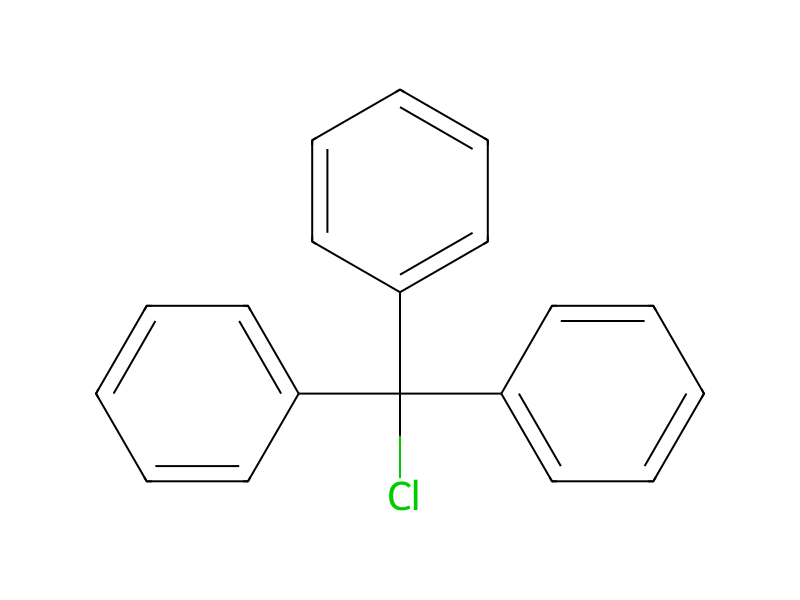
Trityl chloride → Ethyl 1-trityl-1H-imidazole-4-carboxylate
Reaction equation

[NH:1]1[CH:5]=[C:4]([C:6]([O:8][CH2:9][CH3:10])=[O:7])[N:3]=[CH:2]1.C(N(CC)CC)C.[C:18](Cl)([C:31]1[CH:36]=[CH:35][CH:34]=[CH:33][CH:32]=1)([C:25]1[CH:30]=[CH:29][CH:28]=[CH:27][CH:26]=1)[C:19]1[CH:24]=[CH:23][CH:22]=[CH:21][CH:20]=1>C(Cl)(Cl)Cl>[C:18]([N:1]1[CH:5]=[C:4]([C:6]([O:8][CH2:9][CH3:10])=[O:7])[N:3]=[CH:2]1)([C:19]1[CH:24]=[CH:23][CH:22]=[CH:21][CH:20]=1)([C:31]1[CH:32]=[CH:33][CH:34]=[CH:35][CH:36]=1)[C:25]1[CH:26]=[CH:27][CH:28]=[CH:29][CH:30]=1Participants
5
Reactant 3


Product 1

Reagents, catalysts & solvents 1

Procedure
A suspension of ethyl imidazole-4-carboxylate (1.4 g), triethylamine (1.2 g) and chloroform (20 ml) was stirred at room temperature while trityl chloride (3.06 g) was added, and the mixture was stirred at room temperature for 1 h. The resulting solution was washed with water, dried and evaporated to dryness under reduced pressure, and the residue was crystallised from a mixture of ethyl acetate and cyclohexane, to give ethyl 1-tritylimidazole-4-carboxylate, mp 163°-164°.
Workup
- additionwas added
- washThe resulting solution was washed with water
- customdried
- customevaporated to dryness under reduced pressure
- customthe residue was crystallised from a mixture of ethyl acetate and cyclohexane
Sources & evidence
- ORD record
- ord-07f27815e0ab4364a316f9a5418edb32
- Source dataset
- uspto-grants-1990_06
- Patent number
- US04935437
Reaction notes
Loading…