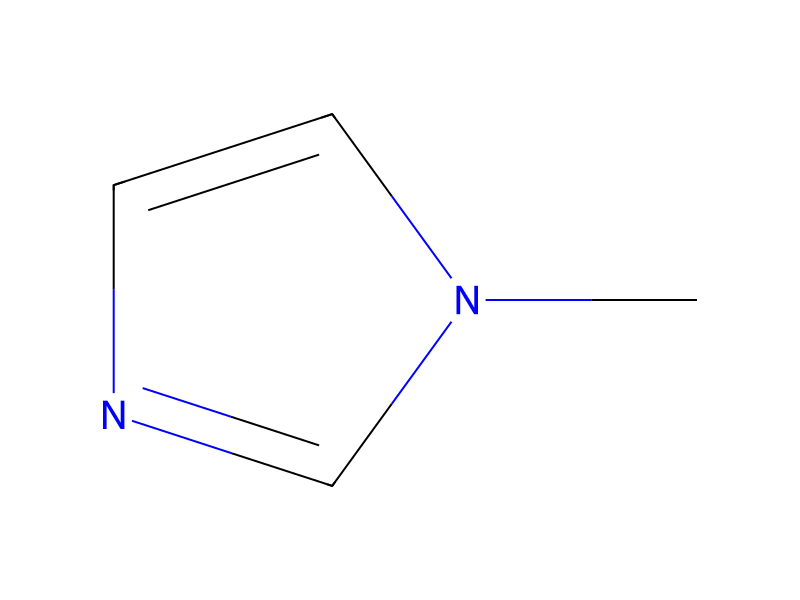
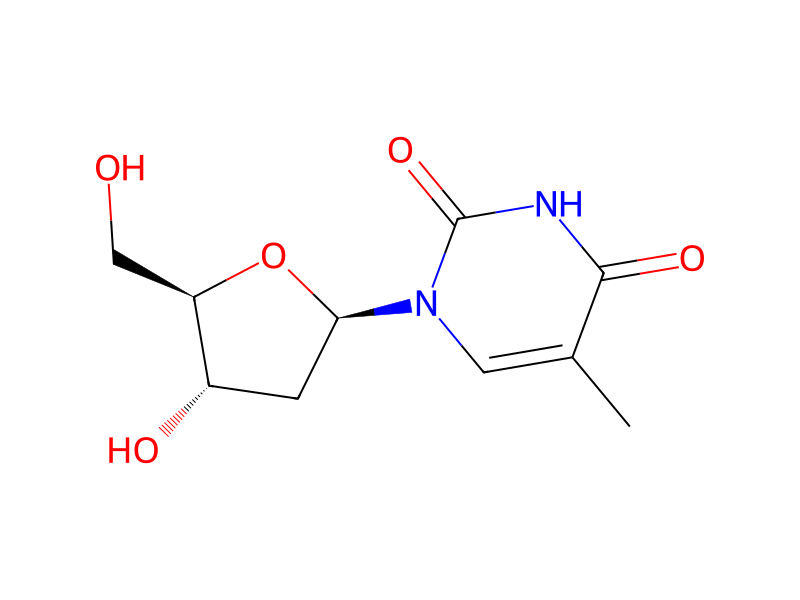
1-Methylimidazole → 2,3'-Anhydrothymidine
Reaction equation

[C@@H:1]1([N:9]2[CH:17]=[C:15]([CH3:16])[C:13](=[O:14])[NH:12][C:10]2=[O:11])[O:8][C@H:5]([CH2:6][OH:7])[C@@H:3](O)[CH2:2]1.S(OC1C=CC=CC=1)(OC1C=CC=CC=1)=O.CN1C=CN=C1.CN(C)C(=O)C>C(O)C.O.C(N(CC)CC)C>[CH3:16][C:15]1[C:13](=[O:14])[N:12]=[C:10]2[N:9]([C@@H:1]3[O:8][C@H:5]([CH2:6][OH:7])[C@@H:3]([O:11]2)[CH2:2]3)[CH:17]=1Participants
Reactant 4


Product 1

Reagents, catalysts & solvents 3



Conditions
- Temperature
- 0 °C
Procedure
A flask containing a stirred mixture of thymidine (5.0 g, 20.6 mmol), diphenyl sulphite (19.34 g, 82.6 mmol), N-methylimidazole (0.34 ml. 4.27 mmol) and N,N-dimethylacetamide (50 ml) was immersed in an oil bath, maintained at 156°±1° C. After 45 minutes, the products were cooled to 0° C. and were then poured, with stirring, into a cooled (0°C.) mixture of triethylamine (50 ml) and water (90 ml). After 40 minutes, by which time it had warmed up almost to room temperature, the resulting solution was extracted with chloroform (4×50 ml). The remaining aqueous layer was concentrated under reduced pressure and the viscous oil obtained was dissolved in absolute ethanol (30 ml), and the solution was re-evaporated. After one further evaporation from absolute ethanol (30 ml) solution, the residue was triturated with ether (3×30 ml). Dichloromethane (50 ml) was then added and the resulting colourless solid precipitate was collected by filtration and washed with dichloromethane (2×10 ml). After the combined filtrate and washings had been concentrated to ca. 30 ml, petroleum ether (b.p. 30°-40° C. 15 ml) was added, and the resulting mixture was refrigerated (4° C.) for 24 hr. A second crop of colourless solid was obtained; it was collected by filtration and was washed with dichloromethane (2×5 ml). The two crops of colourless solid were combined and dried in vacuo at 75° C. to give virtually pure 2,3'-anhydrothymidine [found, in material recrystallized from 90% ethanol and dried in vacuo over P2O5 at 100° C.: C,49.6; H,5.7; N,11.6. C10H12N2O4. H2O requires: C,49.6; H,5.8; N,11.6%]; yield, 3.0 g (64.8%); RF 0.38 [butan-1-ol - acetic acid - water (5:2:3 v/v]; λmax (95% ethanol): 247.5 (ε7 760), λmin 219 nm (ε4 750); δH [d6 -DMSO, 250 MHz]: 1.76(3H,d, J 0.9 Hz), 2.4-2.6 (2H,m), 3.49 (2H,m), 4.19(1H, dt, J 2.4, 6.5 Hz), 5.04 (1H,t, 5.4 Hz), 5.25(1H,m), 5.82 (1H,d, 3.7 Hz , 7.56 (1H,m).
Workup
- additionA flask containing
- customwas immersed in an oil bath
- temperaturemaintained at 156°±1° C
- additionwere then poured
- temperatureinto a cooled
- waitAfter 40 minutes
- temperatureby which time it had warmed up almost to room temperature
- extractionthe resulting solution was extracted with chloroform (4×50 ml)
- concentrationThe remaining aqueous layer was concentrated under reduced pressure
- customthe viscous oil obtained
- customthe solution was re-evaporated
- customAfter one further evaporation from absolute ethanol (30 ml) solution
- customthe residue was triturated with ether (3×30 ml)
- additionDichloromethane (50 ml) was then added
- filtrationthe resulting colourless solid precipitate was collected by filtration
- washwashed with dichloromethane (2×10 ml)
- concentrationAfter the combined filtrate and washings had been concentrated to ca. 30 ml, petroleum ether (b.p. 30°-40° C. 15 ml)
- additionwas added
- custom(4° C.)
- customfor 24 hr
- customA second crop of colourless solid was obtained
- filtrationit was collected by filtration
- washwas washed with dichloromethane (2×5 ml)
- customdried in vacuo at 75° C.
Sources & evidence
- ORD record
- ord-84634d2cf7674d55828bea5309ee5320
- Source dataset
- uspto-grants-1990_06
- Patent number
- US04937329
Reaction notes
Loading…