Diisopropylethylamine → 5-bromo-2-chloro-N-(5-methyl-1H-pyrazol-3-yl)-4-Pyrimidinamine
Reaction equation

[Br:1][C:2]1[C:3](Cl)=[N:4][C:5]([Cl:8])=[N:6][CH:7]=1.[NH2:10][C:11]1[CH:15]=[C:14]([CH3:16])[NH:13][N:12]=1.C(N(CC)C(C)C)(C)C>C(O)CCC>[Br:1][C:2]1[C:3]([NH:10][C:11]2[CH:15]=[C:14]([CH3:16])[NH:13][N:12]=2)=[N:4][C:5]([Cl:8])=[N:6][CH:7]=1Participants
5




Procedure
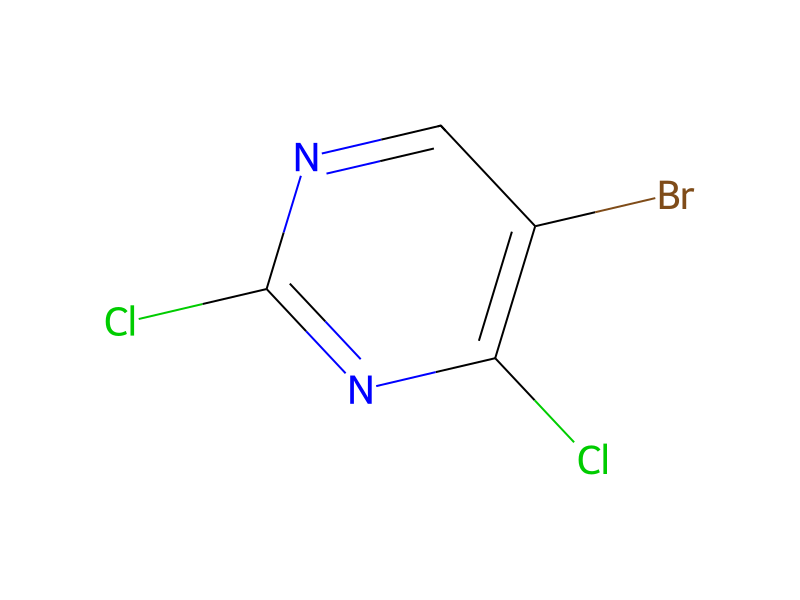
A solution of 5-bromo-2,4-dichloropyrimidine (10.0 g, 44 mmol), 3-amino-5-methyl-1H-pyrazole (6.0 g, 62 mmol) and N,N-diisopropylethylamine (9.20 ml, 53 mmol) in 1-butanol (80 ml) was heated at 85° C. for 12 hours. The mixture was allowed to cool to ambient temperature and the resulting precipitate collected by filtration. The solid product was washed with ethanol and dried to give the sub-titled compound (10.8 g, 85%). 1H NMR (DMSO): δ 2.23 (s, 3H), 6.23 (s, 1H), 8.39 (s, 1H), 9.21 (s, 1H), 12.27 (s, 1H); MS: m/z 290 (MH)+.
Workup
- filtrationthe resulting precipitate collected by filtration
- washThe solid product was washed with ethanol
- customdried
Sources & evidence
- ORD record
- ord-d107a87eff914e16a666f2f870c5e581
- Source dataset
- uspto-grants-2009_04
- Patent number
- US07521453B2
Reaction notes
Loading…