Butylated Hydroxyanisole → 3-t-Butyl-4-trimethylacetoxyanisole
Reaction equation

[C:1]([C:5]1[CH:6]=[C:7]([O:12][CH3:13])[CH:8]=[CH:9][C:10]=1[OH:11])([CH3:4])([CH3:3])[CH3:2].[H-].[Na+].[CH3:16][C:17]([CH3:22])([CH3:21])[C:18](Cl)=[O:19]>CN(C)C=O>[C:1]([C:5]1[CH:6]=[C:7]([O:12][CH3:13])[CH:8]=[CH:9][C:10]=1[O:11][C:18](=[O:19])[C:17]([CH3:22])([CH3:21])[CH3:16])([CH3:4])([CH3:2])[CH3:3]Participants
Reactant 3
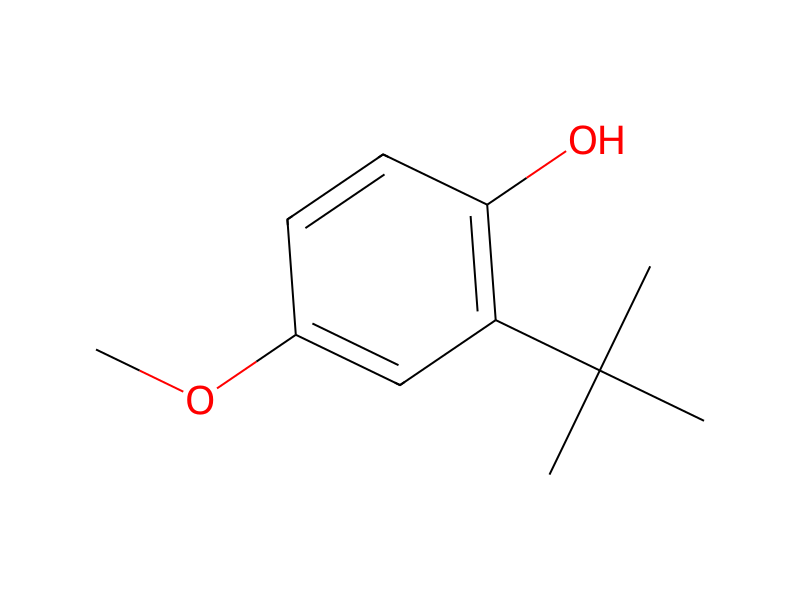


Product 1

Reagents, catalysts & solvents 1

Procedure
5.00 g of 3-t-butyl-4-hydroxyanisole was dissolved in 30 ml of dimethylformamide and the solution was added dropwise into a suspension of 1.33 g of oily sodium hydride in 30 ml of dimethylformamide at 0° C. under a nitrogen stream. After stirring for 30 minutes, 3.76 ml of trimethylacetyl chloride was added dropwise and the solution was stirred overnight and allowed to attain room temperature. After the reaction was quenched with a saturated aqueous ammonium chloride solution, the reaction solution was extracted with water and ethyl acetate. The organic layers were washed with saturated brine, dried over anhydrous magnesium sulfate, and then concentrated. The concentrate was purified by silica gel column chromatography (in n-hexane containing 3%-5% ethyl acetate) to give 5.25 g of 3-t-butyl-4-trimethylacetoxyanisole as a white solid (yield 72%).
Workup
- stirringthe solution was stirred overnight
- customto attain room temperature
- customAfter the reaction was quenched with a saturated aqueous ammonium chloride solution
- extractionthe reaction solution was extracted with water and ethyl acetate
- washThe organic layers were washed with saturated brine
- dry with materialdried over anhydrous magnesium sulfate
- concentrationconcentrated
- customThe concentrate was purified by silica gel column chromatography (in n-hexane containing 3%-5% ethyl acetate)
Sources & evidence
- ORD record
- ord-7cde9e0b93c44871a285fe3c63f94eb5
- Source dataset
- uspto-grants-2004_02
- Patent number
- US06686389B2
Reaction notes
Loading…