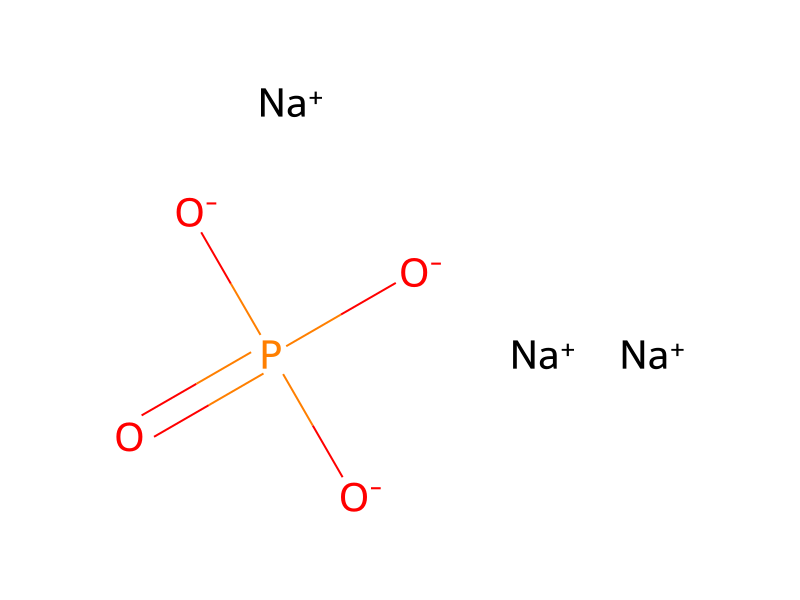
Trisodium Phosphate → HCID 86590266, compound
Reaction equation

[O:1]=[CH:2][CH:3]=[C:4]1[O:10][CH:9]2[N:6]([C:7](=[O:11])[CH2:8]2)[CH:5]1[C:12]([O:14]CC1C=CC=CC=1)=[O:13].P([O-])([O-])([O-])=O.[Na+:27].[Na+].[Na+]>O1CCCC1.[Pd]>[O:1]=[CH:2][CH:3]=[C:4]1[O:10][CH:9]2[N:6]([C:7](=[O:11])[CH2:8]2)[CH:5]1[C:12]([O-:14])=[O:13].[Na+:27]Participants
Reactant 2

Product 1

Reagents, catalysts & solvents 2


Procedure
Benzyl 3-oxoethylidene-7-oxo-4-oxa-1-azabicyclo[3.2.0]heptane-2-carboxylate (II) (50 mg, 0. 17m mol) was dissolved in tetrahydrofuran (5 ml) and 0.2 M sodium phosphate adjusted to pH 6.85 (5 ml), and hydrogenated at ambient temperature and pressure for ten minutes with 10% palladium on carbon (40 mg). The reaction mixture was rapidly filtered and evaporated to dryness while the temperature was maintained below 10° C. The residue was immediately redissolved in D2O to give a solution of the title compound (III). δH(250 MHz, D20) inter alia E isomer 3.25 (1H, d, J 17.4 Hz, 6β-H), 3.65 (1H, dd, J 17.4 and 2.9 Hz, 6 α-H), 5.73 (1H, d, J 1.2 Hz, 2-H), 5.79 (1H, dd, J 8.3 and 1 Hz, 8-H), 5.94 (1H, d, 2.7 Hz, 5-H), 9.55 (1H, d, J 8.3 Hz, 9-H), Z isomer 3.29 (1H, d, J 17.3 Hz, 6β-H), 3.65 (1H, dd, J 17.4 and 2.9 Hz, 6 α-H), 5.27 (1H, s, 2-H), 5.50 (1H, d, J 8.2 Hz, 8-H), 6.00 (1H, d, J2.7 Hz, 5-H), and 9.70 (1H, d, J 8.2 Hz, 9-H). The E and Z isomers were assigned on the relative positions of their 8-proton resonance (Gerald Brooks+Eric Huit J.Chem.Soc. Perkin Trans. I (1983) 2513) and were in the ratio E-Z (2:1). Material prepared by the above hydrogenation with water substituting for the phosphate solution and adjustment of the pH of the reaction mixture to 6.5 with 0.1 M NaOH gave (III) (Yield 35% from NaOH consumed), λmax. (H2O) 262 nm; vmax.(KBr) 3 400, 1 792 (br), and 1 640 cm−1 (br), and 1 640 cm−1 (br); thin layer chromatography on silica 60 eluted with butan- 1-ol-ethanol-water (4:1:1) and visualised with Schiffs reagent gave a blue zone (Rf:0.52). Addition of a known weight of fumaric acid to the crude product solution followed by evaporation and nmr analysis indicated a yield of 20% by comparison of the intensity of the fumarate protons with the intensity of the aldehydic proton of (M). When this solution was allowed to stand at room temperature for 3.5 hours, (III) was seen to have decomposed to a yield of 3.2%.
Workup
- filtrationThe reaction mixture was rapidly filtered
- customevaporated to dryness while the temperature
- temperaturewas maintained below 10° C
- dissolutionThe residue was immediately redissolved in D2O
Sources & evidence
- ORD record
- ord-4f5e67a1da1545b99c9d67b4a4c99774
- Source dataset
- uspto-grants-2004_02
- Patent number
- US06692950B1
Reaction notes
Loading…