Dimethylformamide → 2-(4-chlorobenzenesulphonamido)-N-(3-imidazol-1-ylpropyl)benzamide
Reaction equation

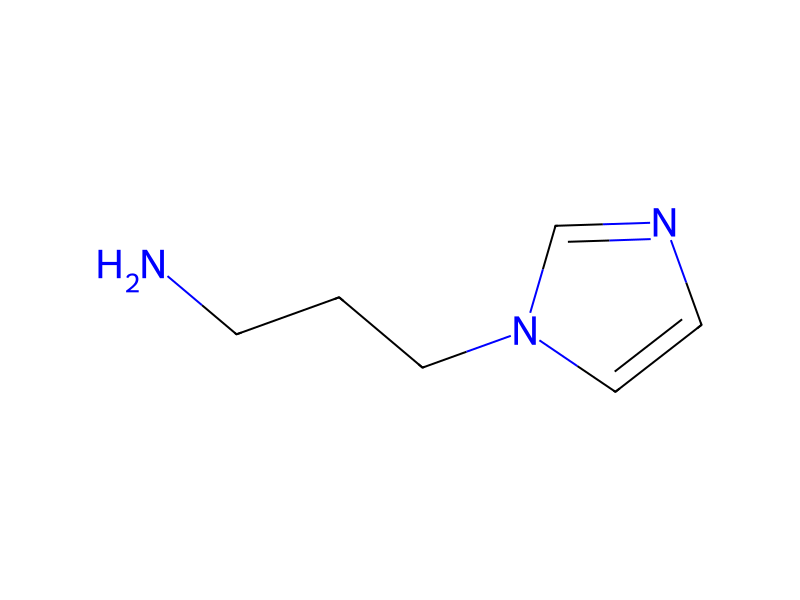
[Cl:1][C:2]1[CH:7]=[CH:6][C:5]([S:8]([NH:11][C:12]2[CH:20]=[CH:19][CH:18]=[CH:17][C:13]=2[C:14](Cl)=[O:15])(=[O:10])=[O:9])=[CH:4][CH:3]=1.[N:21]1([CH2:26][CH2:27][CH2:28][NH2:29])[CH:25]=[CH:24][N:23]=[CH:22]1.C(N(CC)CC)C.CN(C)C=O>O>[Cl:1][C:2]1[CH:7]=[CH:6][C:5]([S:8]([NH:11][C:12]2[CH:20]=[CH:19][CH:18]=[CH:17][C:13]=2[C:14]([NH:29][CH2:28][CH2:27][CH2:26][N:21]2[CH:25]=[CH:24][N:23]=[CH:22]2)=[O:15])(=[O:10])=[O:9])=[CH:4][CH:3]=1Participants





Procedure
2-(4-Chlorobenzenesulphonamido)benzoyl chloride (3.40 g) was added in portions to a stirred mixture of 3-imidazol-1-ylpropylamine (1.29 g), triethylamine (1.04 g) and dimethylformamide (25 ml) at room temperature. The temperature of the mixture rose to 33° C.; the mixture was then stirred at room temperature for 4 hours before pouring into water (500 ml). The aqueous solution was decanted from the crude product which had precipitated as a gum. This gummy material was dissolved in dichloromethane (50 ml), the solution was dried over magnesium sulphate and the solution was evaporated. The crude product was recrystallised from ethyl acetate to give 2-(4-chlorobenzenesulphonamido)-N-(3-imidazol-1-ylpropyl)benzamide, in the form of a white solid, m.p. 175°-177° C. (yield: 2.1 g).
Workup
- customrose to 33° C.
- customThe aqueous solution was decanted from the crude product which
- customhad precipitated as a gum
- dissolutionThis gummy material was dissolved in dichloromethane (50 ml)
- dry with materialthe solution was dried over magnesium sulphate
- customthe solution was evaporated
- customThe crude product was recrystallised from ethyl acetate
Sources & evidence
- ORD record
- ord-84d477dfc8894d0cad76e8045b68b733
- Source dataset
- uspto-grants-1985_03
- Patent number
- US04507315
Reaction notes
Loading…