Hydrochloric Acid → 9-Decenoic acid
Reaction equation

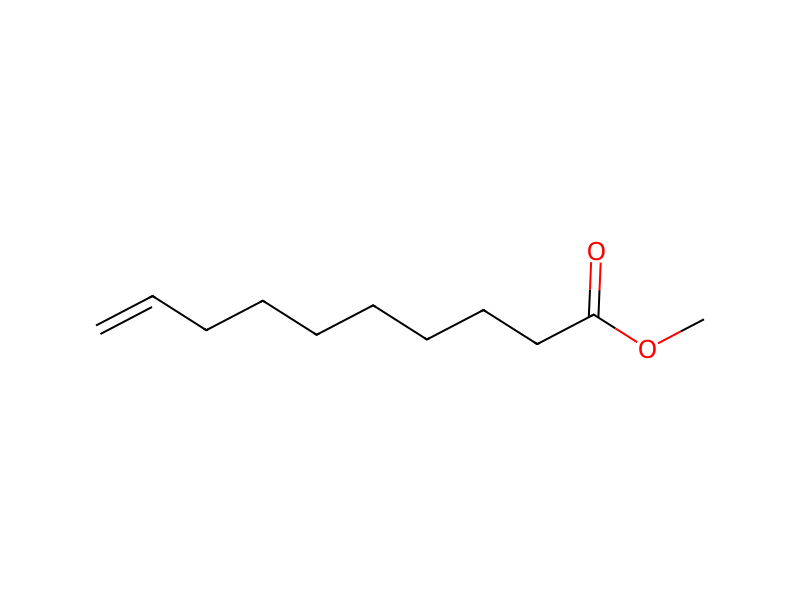
[C:1]([O:12]C)(=[O:11])[CH2:2][CH2:3][CH2:4][CH2:5][CH2:6][CH2:7][CH2:8][CH:9]=[CH2:10].[OH-].[K+].[OH-].Cl>O.C(O)(C)C>[C:1]([OH:12])(=[O:11])[CH2:2][CH2:3][CH2:4][CH2:5][CH2:6][CH2:7][CH2:8][CH:9]=[CH2:10]Participants
Reactant 4


Product 1

Reagents, catalysts & solvents 2


Procedure
In a 5 L 5-neck round bottom flask, 1108.5 g of methyl 9-decenoate, 540 mL water, and 300 mL isopropanol were combined. The flask was connected to a mechanical stirrer, addition funnel, condenser, thermocouple, and stopper. Nitrogen was passed over the headspace for 20 minutes. An aqueous solution of potassium hydroxide (6.6 moles in 660 mL water) was added over 30 minutes, under an atmosphere of nitrogen, at ambient pressure. The reaction temperature peaked at 54° C. The mixture was stirred for a further 4 hours following the addition of aqueous hydroxide addition. After 4 hours, the temperature of the reaction was 28° C. The flask was placed in a water bath and aqueous hydrochloric acid (HCl, 37% (v/v)) was added in portions over 1 hr until the pH was 1-2. The temperature was kept below 40° C. by adding ice to the water bath during the addition of aqueous HCl. The solution was then transferred to a separatory funnel where the organic layer was washed three times with saturated sodium chloride and dried over magnesium sulfate. The magnesium sulfate was removed via vacuum filtration, and the solution was concentrated on the rotary evaporator. The crude product was distilled under reduced pressure (140° C., 2 torr) to provide 9-decenoic acid (995.2 g, 97% yield) as a colorless liquid.
Workup
- additionThe flask was connected to a mechanical stirrer, addition funnel, condenser
- custompeaked at 54° C
- waitAfter 4 hours
- customwas 28° C
- customThe flask was placed in a water bath
- customwas kept below 40° C.
- customThe solution was then transferred to a separatory funnel
- washwhere the organic layer was washed three times with saturated sodium chloride
- dry with materialdried over magnesium sulfate
- customThe magnesium sulfate was removed via vacuum filtration
- concentrationthe solution was concentrated on the rotary evaporator
- distillationThe crude product was distilled under reduced pressure (140° C., 2 torr)
Sources & evidence
- ORD record
- ord-f468e122c9f844119e40962a9e25df82
- Source dataset
- uspto-grants-2015_06
- Patent number
- US09045447B2
Reaction notes
Loading…