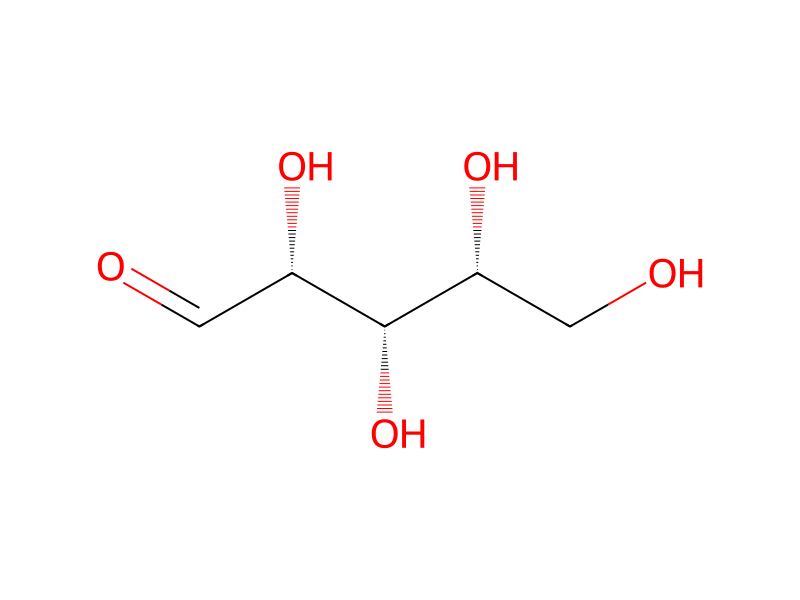
L-Glutamic Acid → (2R,3S,4R,5R)-2,3,4,5,6-pentahydroxyhexanal
Reaction equation

N[C@H](C(O)=O)CC[C:5](O)=[O:6].[O:11]=[CH:12][C@@H:13]([C@H:15]([C@@H:17]([CH2:19][OH:20])[OH:18])[OH:16])[OH:14]>>[O:11]=[CH:12][C@@H:13]([C@H:15]([C@@H:17]([C@@H:19]([CH2:5][OH:6])[OH:20])[OH:18])[OH:16])[OH:14]Participants


Procedure
On the other hand, when the P. ananatis NA1 strain containing pTWVPtac_ccrNXA_Km was cultured with the mixed carbon source of glucose and xylose (MSII-GX medium), the glutamic acid yield was significantly higher as compared to the parent strain (yield: 69.9%). If it is taken into consideration that the parent strain hardly produces glutamic acid from xylose, and it is assumed that the glutamic acid yield from glucose of the strain containing pTWVPtac_ccrNXA_Km is equivalent to that of the parent strain, the yield of glutamic acid produced from xylose via the NXA pathway is about 86%. In fact, when the culture was performed with xylose as the sole carbon source (MSII-Xylose), the strain containing pTWVPtac_ccrNXA_Km produced Glu at a yield of 80% (Table 3).
Sources & evidence
- ORD record
- ord-9fdfae1feea645078f38f5ac1f1c56b5
- Source dataset
- uspto-grants-2015_06
- Patent number
- US09045789B2
Reaction notes
Loading…