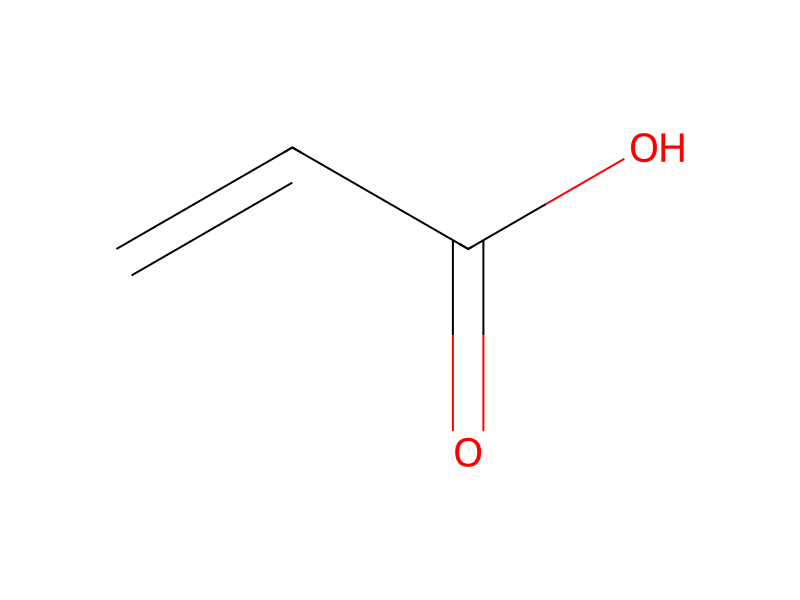
Acrylic Acid → HCID 67154622, compound
Reaction equation

[C:1](O)(=[O:4])[CH:2]=[CH2:3].CN1CCOCC1.ClC(OCC(C)C)=O.Cl.[F:22][C:23]1[CH:36]=[CH:35][C:26]([O:27][CH2:28][CH:29]2[CH2:34][CH2:33][NH:32][CH2:31][CH2:30]2)=[CH:25][CH:24]=1>ClCCl.O>[C:1]([N:32]1[CH2:31][CH2:30][CH:29]([CH2:28][O:27][C:26]2[CH:25]=[CH:24][C:23]([F:22])=[CH:36][CH:35]=2)[CH2:34][CH2:33]1)(=[O:4])[CH:2]=[CH2:3]Participants
7





Conditions
- Temperature
- 0 °C
Procedure
To a solution of acrylic acid (34 μL, 0.49 mmol) in dichloromethane (2.4 mL) cooled at 0° C. was added 4-methylmorpholine (134 μL, 1.22 mol) and isobutyl chloroformate (74 μL, 0.57 mmol). The solution was stirred 15 minutes at 0° C. and then 4-[(4-fluorophenoxy)methyl]piperidine hydrochloride (100 mg, 0.41 mmol) was added. The mixture was stirred at room temperature overnight, diluted with water (7 mL) and extracted twice with DCM (2×5 mL). The combined organic phases were washed with water, dried over sodium sulphate and concentrated in vacuo. The residue obtained was purified by preparative TLC (eluent: dichloromethane/MeOH 95/5) to give the title compound (30 mg, 28%) as a yellow oil.
Workup
- stirringThe mixture was stirred at room temperature overnight
- extractionextracted twice with DCM (2×5 mL)
- washThe combined organic phases were washed with water
- dry with materialdried over sodium sulphate
- concentrationconcentrated in vacuo
- customThe residue obtained
- customwas purified by preparative TLC (eluent: dichloromethane/MeOH 95/5)
Sources & evidence
- ORD record
- ord-203d34645d134c00a382d220ddb29261
- Source dataset
- uspto-grants-2015_06
- Patent number
- US09051321B2
Reaction notes
Loading…