4-Hydroxybenzoic Acid → HCID 66598738, compound
Reaction equation

[OH:1][C:2]1[CH:10]=[CH:9][C:5]([C:6]([OH:8])=[O:7])=[CH:4][CH:3]=1.[Br:11][CH2:12][CH2:13][CH2:14][CH2:15][CH2:16][CH2:17][CH2:18][CH2:19][CH2:20][CH2:21][CH2:22][CH2:23]Br.C(OCC)(=O)C>CN1CCCC1=O>[OH:1][C:2]1[CH:10]=[CH:9][C:5]([C:6]([O:8][CH2:23][CH2:22][CH2:21][CH2:20][CH2:19][CH2:18][CH2:17][CH2:16][CH2:15][CH2:14][CH2:13][CH2:12][Br:11])=[O:7])=[CH:4][CH:3]=1Participants
Reactant 3
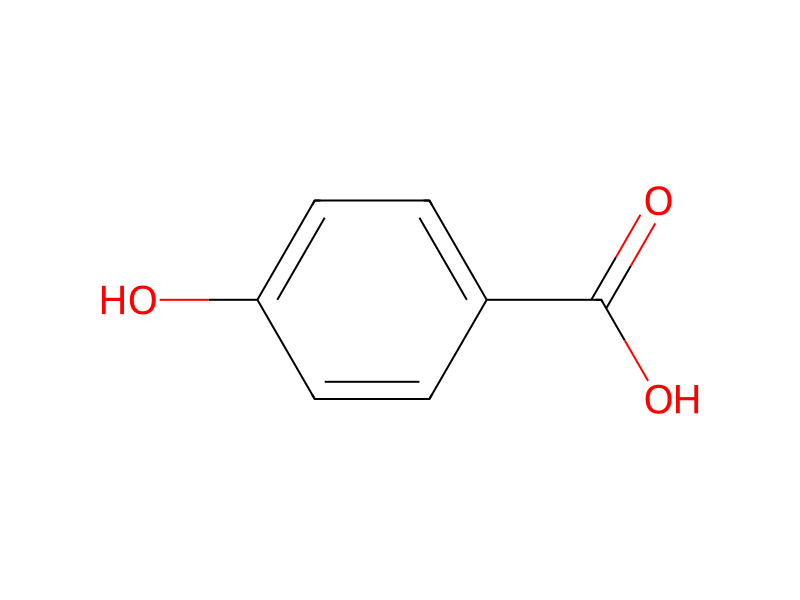


Product 1

Reagents, catalysts & solvents 1

Conditions
- Temperature
- 0 °C
Procedure
6.32 Gram of 4-hydroxybenzoic acid was dissolved in 100 mL of N-methylpyrrolidone, 6.96 g of diaza(1,3)bicyclo[5.4.0]undecane was added thereto, and the resulting mixture was cooled to 0° C. in a nitrogen stream. Thereto, 50 mL of an N-methylpyrrolidone solution having dissolved therein 15 g of 1,12-dibromododecane was added dropwise over 0.2 hours, and the obtained reaction solution was stirred at 0° C. for 2 hours and further stirred at 50° C. for 4 hours. After adding 200 mL of ethyl acetate, the organic layer was washed, in sequence, twice with an aqueous saturated sodium hydrogencarbonate solution and twice with water and dried over sodium sulfate. The solvent was concentrated, and the residue was purified by column chromatography (SiO2, hexane/ethyl acetate=2/1) to obtain 10.2 g of 12-bromododecyl 4-hydroxybenzoate as a transparent oil. Thereafter, 4.62 g of the oil and 3.79 g of 1,1,2,2,3,3-hexafluoropropane-1,3-disulfonyl difluoride were dissolved in 100 mL of acetonitrile, and the resulting solution was cooled to 0° C. Thereto, 50 mL of an acetonitrile solution having dissolved therein 1.83 g of diaza(1,3)bicyclo[5.4.0]undecane was added dropwise over 0.5 hours, and the obtained reaction solution was stirred at 0° C. for 1 hour and further stirred at room temperature for 3 hours. After adding 200 mL of ethyl acetate, the organic layer was washed, in sequence, twice with an aqueous saturated sodium hydrogencarbonate solution and twice with water and dried over sodium sulfate. The solvent was concentrated, and the transparent oil as residue was dissolved in a mixed solution of 100 ml of methanol and 50 ml of acetone. Thereto, 10 g of sodium hydrogencarbonate as solid was added, and the mixture was stirred at 40° C. for 5 hours. After adding 200 mL of ethyl acetate, the organic layer was washed, in sequence, twice with saturated brine and twice with water and dried over sodium sulfate. The residue was recrystallized from hexane to obtain 5.0 g of sodium 3-((4-((12-bromododecyloxy)carbonyl)phenoxy)sulfonyl)-1,1,2,2,3,3-hexafluoropropane-1-sulfonate as a white solid. Thereafter, 3.0 g of this solid was dissolved in 100 mL of acetonitrile, and 0.81 g of methacrylic acid, 1.44 g of diaza(1,3)bicyclo[5.4.0]undecane and 50 mL of methanol were sequentially added thereto, followed by stirring at 70° C. for 3 hours in a nitrogen stream. After adding 200 mL of ethyl acetate, the organic layer was washed, in sequence, twice with an aqueous saturated sodium hydrogencarbonate solution and twice with water and dried over sodium sulfate. The solvent was concentrated to obtain 2.82 g of sodium 3-((4-((12-(methacryloyloxy)dodecyloxy)carbonyl)phenoxy)sulfonyl)-1,1,2,2,3,3-hexafluoropropane-1-sulfonate. Furthermore, 3.64 g of this solid was dissolved in 50 mL of methanol, and 1.77 g of triphenylsulfonium bromide was added thereto, followed by stirring at room temperature for 3 hours. After adding 200 mL of chloroform, the organic layer was washed with water, and the solvent was concentrated, as a result, 4.1 g of a transparent oily compound was obtained. 1H-NMR (300 MHz, CDCl3) δ 1.26-1.45 (m, 14H), 1.67 (m, 2H), 1.76 (quintet, 2H), 1.94 (s, 3H), 4.13 (m, 4H), 4.32 (t, 2H), 5.54 (s, 1H), 6.09 (s, 1H), 7.55 (d, 2H), 7.69-7.78 (m, 15H), 8.11 (d, 2H), 19F-NMR (300 MHz, CDCl3) δ −107.0 (m, 2F), −114.0 (m, 2F), −118.4 (m, 2F).
Workup
- customthe obtained reaction solution
- stirringfurther stirred at 50° C. for 4 hours
- washthe organic layer was washed, in sequence, twice with an aqueous saturated sodium hydrogencarbonate solution and twice with water
- dry with materialdried over sodium sulfate
- concentrationThe solvent was concentrated
- customthe residue was purified by column chromatography (SiO2, hexane/ethyl acetate=2/1)
Sources & evidence
- ORD record
- ord-212e4e42cb1b442486c49ee8a6362392
- Source dataset
- uspto-grants-2015_06
- Patent number
- US09051403B2
Reaction notes
Loading…