3-Phenylprop-2-En-1-Ol → HCID 11829623, compound
Reaction equation

C([CH2:9][OH:10])=CC1C=CC=CC=1.[CH3:11][C:12]1[CH:19]=[CH:18][C:15]([CH:16]=[CH2:17])=[CH:14][CH:13]=1.CO>C1(C)C(C)=CC=CC=1>[CH3:9][O:10][CH:16]([C:15]1[CH:18]=[CH:19][C:12]([CH3:11])=[CH:13][CH:14]=1)[CH3:17]Participants
Reactant 3
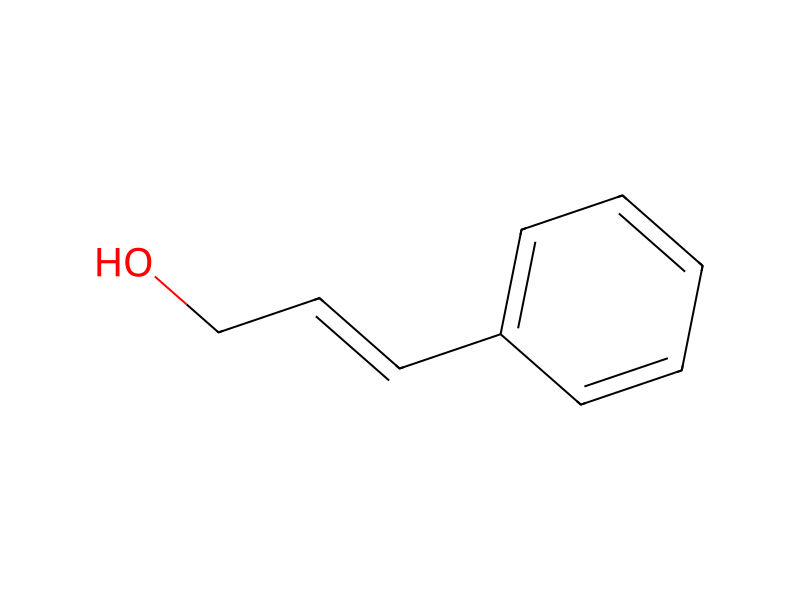


Product 1

Reagents, catalysts & solvents 1

Procedure
The RPlug reactor model of ASPEN PLUS® (Ver. 7.1) is used to model the plug flow reactor (PFR) for the reaction of styrene (A8) with methanol to form the methanol styrene ether (MSE) (i.e. 1-methoxyethylbenzene). Laboratory rate data of the reaction in xylene solvent shows an empirical relationship that is directly proportional to styrene concentration and inversely proportional to methanol concentration. It considers the effect of methanol adsorption to account for an enhanced rate at low methanol concentrations, while also accounting for inhibition of methanol at very high methanol concentrations. The reaction model also takes into account the reverse reaction by including the equilibrium constant (Keqm) which is taken from the literature (Verevkin et. al., J. Chem. Eng. Data, 46, 984-990, 2001). The NRTL-RK property method is used for vapour-liquid equilibrium calculations. Binary interaction parameters were estimated for binary pairs involving MSE and for styrene-methanol. The reaction of 4-methylstyrene (A9) and methanol to form 1-(4-methylphenyl)ethyl methyl ether (4MMSE) is modeled as a side reaction. The reaction rate was estimated from conversion data found in the literature (Zhang and Corma, Royal Society of Chemistry, 2007, Chem. Commun. 2007, 3080-3082). Since both product components (MSE and 4MMSE) are not found in the ASPEN PLUS® database, Aspen Properties using the group contribution method of GANI were used to estimate boiling point temperatures and other critical constants. In this case, the reactor is designed as a constant temperature PFR operating at 100° C. It is sized for a 1 mol/h flow of styrene in a feed mixture containing 0.2433 mass fraction of styrene in xylene. An inert, unreactive C9H12 component present at 0.1957 mass fraction is included and modeled as 1-methyl-4-ethylbenzene. FIG. 5 is a schematic representation of a 1-stage plug flow reactor 402 for methanol styrene ether synthesis. The feed 406 contains styrene, methylstyrene and inert C8 and C9 compounds. Since Methanol to feed ratio in excess of the stoichiometric requirements are used, the effluent 410 from reactor 402 is sent to distillation column 107 to separate the methanol and unreacted feed compounds 409 from product ethers 136. Stream 409 is recycled and mixed with feed 406 and methanol stream 405. The mixture 407 then enters reactor 402.
Workup
- concentrationis directly proportional to styrene concentration and inversely proportional to methanol concentration
- concentrationto account for an enhanced rate at low methanol concentrations
- concentrationwhile also accounting for inhibition of methanol at very high methanol concentrations
- customthe reverse reaction
Sources & evidence
- ORD record
- ord-4f34d0efb14846048f89b06f3ef2fc58
- Source dataset
- uspto-grants-2015_06
- Patent number
- US09067846B2
Reaction notes
Loading…