3,4-dihydro-2H-pyran → HCID 90418301, compound
Reaction equation

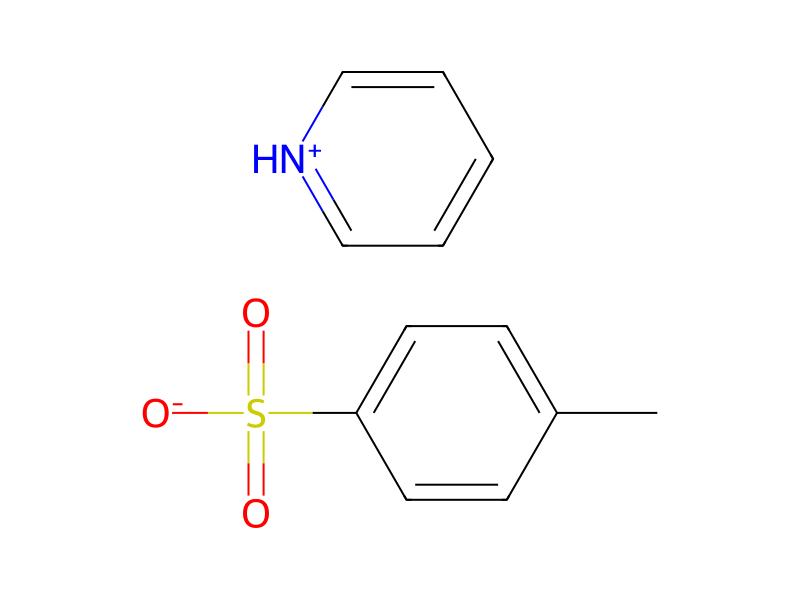
[Br:1][C:2]1[S:6][C:5]([CH2:7][OH:8])=[C:4]([C:9]2[CH:14]=[CH:13][C:12]([Cl:15])=[CH:11][CH:10]=2)[CH:3]=1.CC1C=CC(S([O-])(=O)=O)=CC=1.C1C=C[NH+]=CC=1.[O:33]1[CH:38]=[CH:37][CH2:36][CH2:35][CH2:34]1>ClCCl>[Br:1][C:2]1[S:6][C:5]([CH2:7][O:8][CH:34]2[CH2:35][CH2:36][CH2:37][CH2:38][O:33]2)=[C:4]([C:9]2[CH:14]=[CH:13][C:12]([Cl:15])=[CH:11][CH:10]=2)[CH:3]=1Participants
5
Reactant 3


Product 1

Reagents, catalysts & solvents 1

Procedure
Into a 250-mL round-bottom flask, was placed [5-bromo-3-(4-chlorophenyl)thiophen-2-yl]methanol (4.8 g, 15.81 mmol, 1.00 equiv), dichloromethane (100 mL), PPTS (100 mg, 0.40 mmol, 0.03 equiv), 3,4-dihydro-2H-pyran (2.67 g, 31.74 mmol, 2.01 equiv). The resulting solution was stirred for 3 h at room temperature. The resulting mixture was concentrated under vacuum. The residue was applied onto a silica gel column with ethyl acetate/petroleum ether (1:5). This resulted in 5.0 g (82%) of 2-[[5-bromo-3-(4-chlorophenyl)thiophen-2-yl]methoxy]oxane as yellow oil.
Workup
- customInto a 250-mL round-bottom flask, was placed
- concentrationThe resulting mixture was concentrated under vacuum
- customThis resulted in 5.0 g (82%) of 2-[[5-bromo-3-(4-chlorophenyl)thiophen-2-yl]methoxy]oxane as yellow oil
Sources & evidence
- ORD record
- ord-bda8a96e45264462bd4341c48f8230c0
- Source dataset
- uspto-grants-2015_06
- Patent number
- US09067898B1
Reaction notes
Loading…