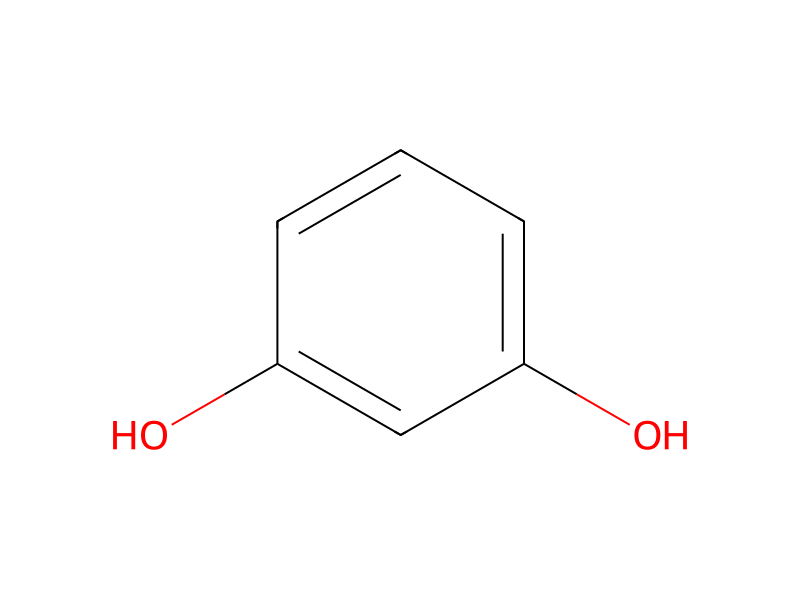
Resorcinol → Benzyl 3-hydroxyphenyl ether
Reaction equation

[C:1]1([CH:8]=[CH:7][CH:6]=[C:4]([OH:5])[CH:3]=1)[OH:2].[CH2:9](Cl)[C:10]1[CH:15]=[CH:14][CH:13]=[CH:12][CH:11]=1.C([O-])([O-])=O.[K+].[K+]>O>[C:10]1([CH2:9][O:2][C:1]2[CH:3]=[C:4]([OH:5])[CH:6]=[CH:7][CH:8]=2)[CH:15]=[CH:14][CH:13]=[CH:12][CH:11]=1Participants
Reactant 3


Product 1

Reagents, catalysts & solvents 1

Procedure
36.6 g (332.40 mmol) of resorcinol and 42 g (331.78 mmol) of benzyl chloride are refluxed overnight in 250 ml of dry Me2CO in the presence of 46.6 g of K2CO3, with stirring. The mixture is cooled, filtered and evaporated. The residue obtained is diluted in 500 ml of water and extracted with ethanol. The organic layer is washed with 10% aqueous NaOH and extracted with ethanol. The red oil obtained is distilled with the aid of a bulb tube distillation apparatus to give 18 g of m-PhCH2OC6H4OH, b.p.15 240-245° C. (lit. b.p.11 202-210° C.). A solution of 3.3 g (16.5 mmol) of m-PhCH2OC6H4OH in 50 ml of DMF is treated with 0.8 g (16.5 mmol) of sodium hydride and the mixture is stirred for 15 minutes. After the addition of 13.75 ml (16.5 mmol) of epichlorohydrin, the mixture is stirred at 60° C. for one hour until alkylation is complete. The excess reagent and the solvent are evaporated off under reduced pressure and the residue is partitioned between the following two phases: ethyl acetate and water. The organic phase yields the epoxide, which is used without further purification.
Workup
- temperatureThe mixture is cooled
- filtrationfiltered
- customevaporated
- customThe residue obtained
- extractionextracted with ethanol
- washThe organic layer is washed with 10% aqueous NaOH
- extractionextracted with ethanol
- customThe red oil obtained
- distillationis distilled with the aid of a bulb tube
- distillationdistillation apparatus
Sources & evidence
- ORD record
- ord-f5aaf8debb164e96a3e566559d54bc29
- Source dataset
- uspto-grants-2005_05
- Patent number
- US06890955B2
Reaction notes
Loading…