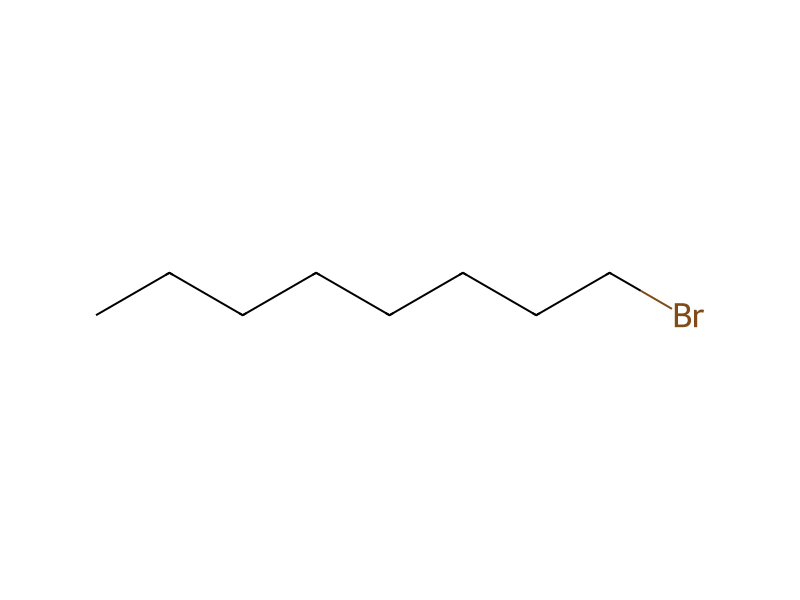
1-Bromooctane → 2,7-Dibromo-9,9-di-n-octylfluorene
Reaction equation

[Br:1][C:2]1[CH:14]=[CH:13][C:12]2[C:11]3[C:6](=[CH:7][C:8]([Br:15])=[CH:9][CH:10]=3)[CH2:5][C:4]=2[CH:3]=1.Br[CH2:17][CH2:18][CH2:19][CH2:20][CH2:21][CH2:22][CH2:23][CH3:24].[OH-].[Na+]>[Br-].C([N+](CCCC)(CCCC)CCCC)CCC.CS(C)=O.O>[CH2:17]([C:5]1([CH2:13][CH2:14][CH2:2][CH2:3][CH2:4][CH2:12][CH2:11][CH3:10])[C:4]2[CH:3]=[C:2]([Br:1])[CH:14]=[CH:13][C:12]=2[C:11]2[C:6]1=[CH:7][C:8]([Br:15])=[CH:9][CH:10]=2)[CH2:18][CH2:19][CH2:20][CH2:21][CH2:22][CH2:23][CH3:24]Participants






Conditions
- Temperature
- 60 °C
Procedure
In a 3-neck round-bottom flask (1,000 ml) equipped with a reflux condenser and an electronic thermometer, 2,7-dibromofluorene (64.8 g, 200 mmol, 1 eq.), 1-bromooctane (154.5 g, 800 mmol, 4 eq.), and tetrabutylammonium bromide (6.44 g, 20 mmol, 1/10 eq.) were dissolved in DMSO (dimethyl sulfoxide, 500 ml) under the protection of nitrogen. An aqueous solution of sodium hydroxide (32.0 g, 0.8 mol, 4 eq.) in water (40 ml) was dropped into the resulting light yellow solution with the speed of dropping controlled not to pass 60° C. The resulting brownish red reaction mixture was heated and stirred at 60° C. overnight. After it was allowed to cool down to room temperature, water (500 ml) was poured and the resulting mixture was stirred briefly and totally transferred into a separatory funnel (2,000 ml). The aqueous layer was separated and extracted with hexane (3×200 ml). The hexane extracts were combined, washed with 1 M hydrochloric acid (2×50 ml) and then with water (4×100 ml), and dried over MgSO4 (magnesium sulfate) overnight. The drying agent was filtered away and the filtrate was removed on a rotary evaporator. The reddish yellow residue was slowly poured into well-stirred methanol (1,000 ml) in an Erlenmeyer flask (2,000 ml). The resulting yellow precipitates were filtered out, crashed, washed with methanol (3×100 ml), and dried under suction and then in a vacuum oven at 40° C. and 3 in./Hg overnight. A white crystal (98.0 g) was collected with the yield of 89.3% with a melting point 63-65° C.
Workup
- customIn a 3-neck round-bottom flask (1,000 ml) equipped with a reflux condenser
- customto pass 60° C
- customThe resulting brownish red reaction mixture
- temperaturewas heated
- temperatureto cool down to room temperature
- stirringthe resulting mixture was stirred briefly
- customtotally transferred into a separatory funnel
- customThe aqueous layer was separated
- extractionextracted with hexane (3×200 ml)
- washwashed with 1 M hydrochloric acid (2×50 ml)
- dry with materialwith water (4×100 ml), and dried over MgSO4 (magnesium sulfate) overnight
- filtrationThe drying agent was filtered away
- customthe filtrate was removed on a rotary evaporator
- additionThe reddish yellow residue was slowly poured
- stirringinto well-stirred methanol (1,000 ml) in an Erlenmeyer flask (2,000 ml)
- customThe resulting yellow precipitates
- filtrationwere filtered out
- washwashed with methanol (3×100 ml)
- customdried under suction
- customat 40° C.
- customHg overnight
- customA white crystal (98.0 g) was collected with the yield of 89.3% with a melting point 63-65° C.
Sources & evidence
- ORD record
- ord-11ba145ecead4c89a19d5d3d62706fd9
- Source dataset
- uspto-grants-2005_05
- Patent number
- US06894145B2
Reaction notes
Loading…