Hydrazine → 2-(4-acetylpiperazinyl)-N-aminoacetamide
Reaction equation

Br[CH2:2][C:3]([O:5]C)=O.[C:7]([N:10]1[CH2:15][CH2:14][NH:13][CH2:12][CH2:11]1)(=[O:9])[CH3:8].C(=O)([O-])[O-].[K+].[K+].[NH2:22][NH2:23]>C(O)C>[C:7]([N:10]1[CH2:15][CH2:14][N:13]([CH2:2][C:3]([NH:22][NH2:23])=[O:5])[CH2:12][CH2:11]1)(=[O:9])[CH3:8]Participants
6
Reactant 4



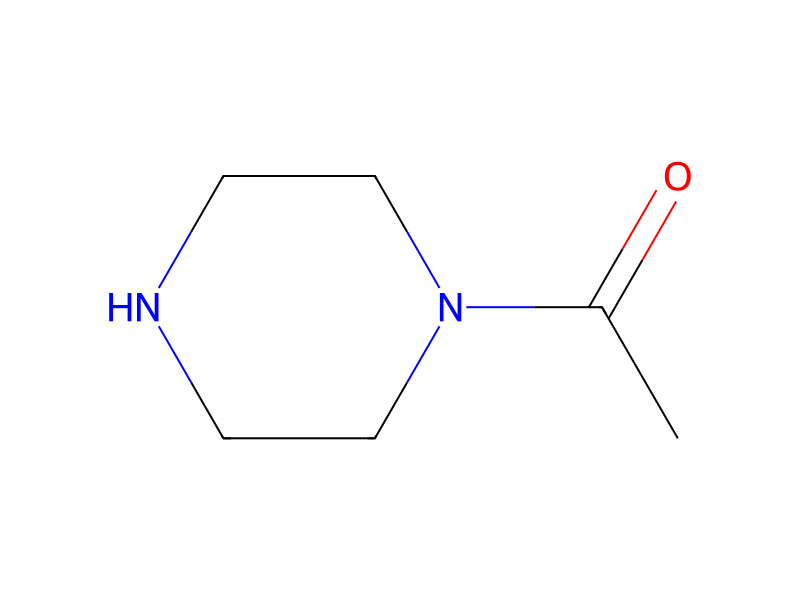
Product 1

Reagents, catalysts & solvents 1

Conditions
- Temperature
- 85 °C
Procedure
The procedure described for Example 283 A was followed using methyl bromoacetate (1.5 g, 0.01 mol), 1-acetyl piperazine (1.4 g, 0.011 mol), and potassium carbonate (1.52 g, 0.011 mol). After one day, an additional 0.3 equivalent of methyl bromoacetate was added to the reaction. The crude material was taken up in approximately 152 mL of ethanol and hydrazine was added to the solution (0.25 mL, 0.008 mol). This was heated in a sealed tube at 85° C. for 4 hours. The solvent was removed to yield the title compound (1.6 g, 80% yield). 1H NMR (DMSO-d6) δ 9.0 (s, 1H), 4.2 (br s, 2H), 3.5 (m, 4H), 2.9 (s, 2H), 2.4 (m, 4H), 2.0 (s, 3H).
Workup
- customThe solvent was removed
Sources & evidence
- ORD record
- ord-317044e807ea4fada5507255564471a3
- Source dataset
- uspto-grants-2005_05
- Patent number
- US06897231B2
Reaction notes
Loading…