Potassium Carbonate → 4-(Pyridin-4-yl)benzoic acid
Reaction equation

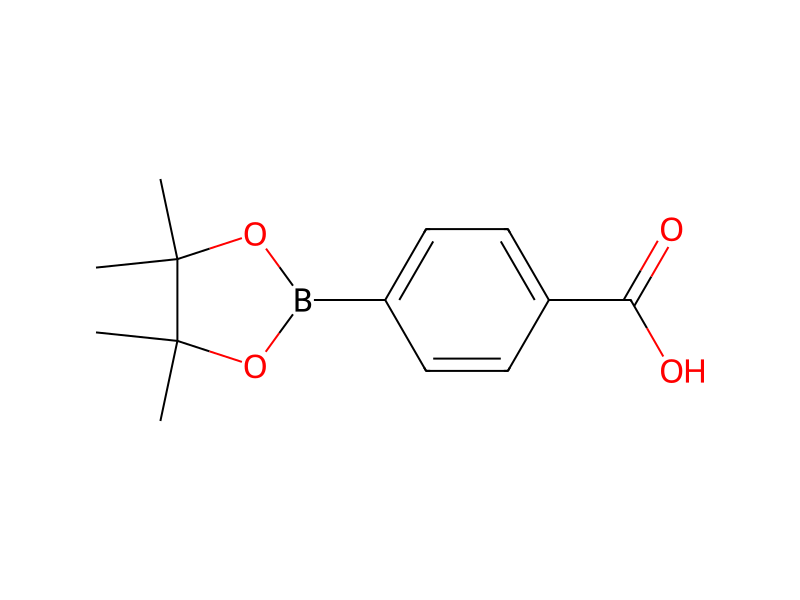
Cl.Br[C:3]1[CH:8]=[CH:7][N:6]=[CH:5][CH:4]=1.CC1(C)C(C)(C)OB([C:17]2[CH:25]=[CH:24][C:20]([C:21]([OH:23])=[O:22])=[CH:19][CH:18]=2)O1.C(=O)([O-])[O-].[K+].[K+]>CN(C)C=O.C1C=CC([P]([Pd]([P](C2C=CC=CC=2)(C2C=CC=CC=2)C2C=CC=CC=2)([P](C2C=CC=CC=2)(C2C=CC=CC=2)C2C=CC=CC=2)[P](C2C=CC=CC=2)(C2C=CC=CC=2)C2C=CC=CC=2)(C2C=CC=CC=2)C2C=CC=CC=2)=CC=1>[N:6]1[CH:7]=[CH:8][C:3]([C:17]2[CH:25]=[CH:24][C:20]([C:21]([OH:23])=[O:22])=[CH:19][CH:18]=2)=[CH:4][CH:5]=1Participants
6
Reactant 3


Product 1

Reagents, catalysts & solvents 2


Conditions
- Temperature
- 80 °C
Procedure
4-Bromopyridine hydrochloride (0.4 g, 2 mmol), 4-(4,4,5,5-tetramethyl-1,3,2-dioxaborolan-2-yl)benzoic acid (0.5 g, 2 mmol), and tetrakis(triphenylphosphine)palladium(0) (50 mg, 0.04 mmol) in dimethylformamide (15 mL) was treated with 2M potassium carbonate (2 mL) and the mixture was heated to 80° C. for 16 h. The mixture was concentrated in vacuo and the residue was diluted with water to afford a solid which was filtered to afford the title compound (0.26 g).
Workup
- concentrationThe mixture was concentrated in vacuo
- additionthe residue was diluted with water
- customto afford a solid which
- filtrationwas filtered
Sources & evidence
- ORD record
- ord-2c9b561b32c24dc7bd0eb70f61523f77
- Source dataset
- uspto-grants-2002_06
- Patent number
- US06399656B1
Reaction notes
Loading…