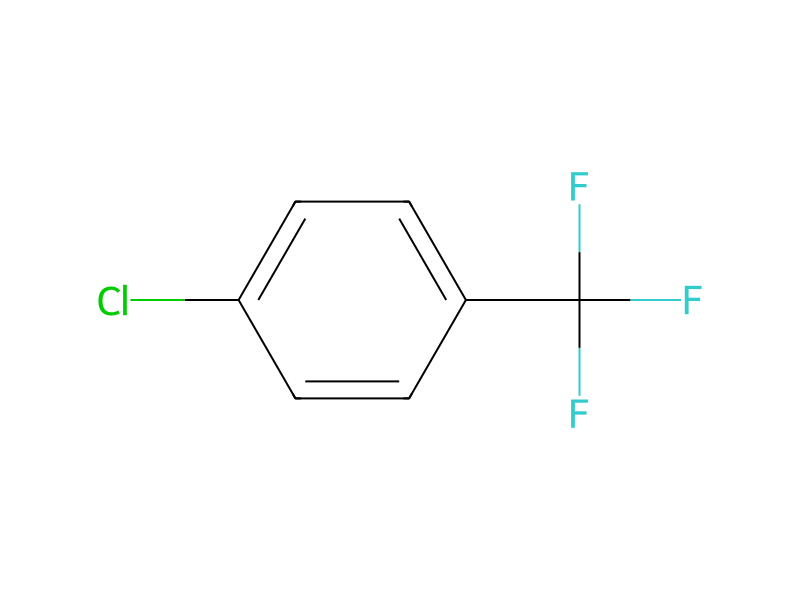
1-Chloro-4-(trifluoromethyl)benzene → 4-(Trifluoromethyl)phenylhydrazine
Reaction equation

Cl[C:2]1[CH:7]=[CH:6][C:5]([C:8]([F:11])([F:10])[F:9])=[CH:4][CH:3]=1.O.[NH2:13][NH2:14]>N1C=CC=CC=1>[F:9][C:8]([F:11])([F:10])[C:5]1[CH:6]=[CH:7][C:2]([NH:13][NH2:14])=[CH:3][CH:4]=1Participants
4
Reactant 2

Product 1

Reagents, catalysts & solvents 1

Conditions
- Temperature
- 180 °C
Procedure
A mixture of 4-chlorobenzotrifluoride (1.08 g), hydrazine hydrate (1.8 g, 6 molar equivalents) and pyridine (5 ml) was heated in an autoclave (purged with argon) for 6 hours at 180° C. The mixture was cooled, the excess hydrazine decanted and the organic phase evaporated in vacuo. The residue was crystallised from petroleum ether to give the title compound in 20% yield. It was shown that 20% of the starting material had been consumed, thus indicating that the reaction had occurred with high selectivity.
Workup
- temperatureThe mixture was cooled
- customthe excess hydrazine decanted
- customthe organic phase evaporated in vacuo
- customThe residue was crystallised from petroleum ether
Sources & evidence
- ORD record
- ord-c1a8c17a6cbf4691b7b37d844a28a21d
- Source dataset
- uspto-grants-2002_06
- Patent number
- US06410737B1
Reaction notes
Loading…