Water → HCID 68671102, compound
Reaction equation

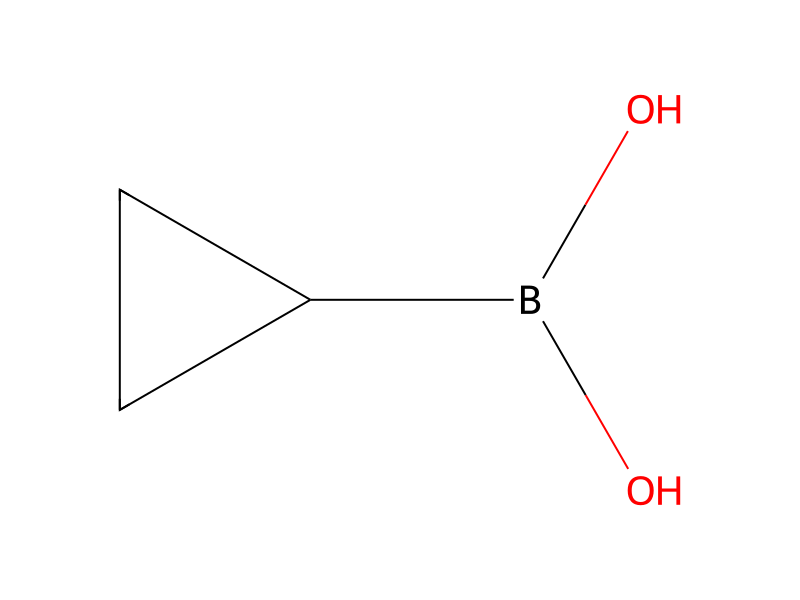
[Br:1][C:2]1[CH:3]=[C:4]([C:12](=[CH:18][CH:19]2[CH2:23][CH2:22][C:21]3([O:28][CH2:27][C:26]([CH3:30])([CH3:29])[CH2:25][O:24]3)[CH2:20]2)[C:13]([O:15][CH2:16][CH3:17])=[O:14])[CH:5]=[CH:6][C:7]=1[S:8][CH:9]1[CH2:11][CH2:10]1.C1(B(O)[OH:35])CC1.P([O-])([O-])([O-])=O.[K+].[K+].[K+].[OH2:45]>C1(C)C=CC=CC=1.C1C=CC([P]([Pd]([P](C2C=CC=CC=2)(C2C=CC=CC=2)C2C=CC=CC=2)([P](C2C=CC=CC=2)(C2C=CC=CC=2)C2C=CC=CC=2)[P](C2C=CC=CC=2)(C2C=CC=CC=2)C2C=CC=CC=2)(C2C=CC=CC=2)C2C=CC=CC=2)=CC=1.C(OCC)(=O)C>[Br:1][C:2]1[CH:3]=[C:4]([C:12](=[CH:18][CH:19]2[CH2:23][CH2:22][C:21]3([O:24][CH2:25][C:26]([CH3:29])([CH3:30])[CH2:27][O:28]3)[CH2:20]2)[C:13]([O:15][CH2:16][CH3:17])=[O:14])[CH:5]=[CH:6][C:7]=1[S:8]([CH:9]1[CH2:11][CH2:10]1)(=[O:35])=[O:45]Participants
Reactant 4



Product 1

Reagents, catalysts & solvents 3



Conditions
- Temperature
- 100 °C
Procedure
Ethyl 2-[3-bromo-4-(cyclopropylsulfanyl)phenyl]-3-(8,8-dimethyl-6,10-dioxaspiro[4.5]dec-2-yl)acrylate (2.40 g, (E)/(Z)-mixture), cyclopropylboronic acid (606 mg, 7.05 mmol), and tetrakis(triphenylphosphine)palladium (272 mg, 0.24 mmol) were dissolved in toluene (72 mL), and to this solution were added tripotassium phosphate (1.80 g, 8.46 mmol) and water (3.6 mL). The mixture was stirred at 100° C. for 20 hours. It was cooled to room temperature, and water and ethyl acetate were added thereto. The organic layer was separated, washed with a saturated aqueous sodium hydrogen carbonate solution and saturated brine, and then dried over anhydrous magnesium sulfate. After concentration under reduced pressure, the obtained residue was purified by silica gel column chromatography. The obtained intermediate was dissolved in dichloromethane (48 mL), followed by ice-cooling. To this solution were added sodium hydrogen carbonate (3.95 g) and then m-chloroperbenzoic acid (1.30 g). It was warmed to room temperature and stirred for 1 hour. Water was added to the reaction mixture to stop the reaction, and 1 M aqueous sodium sulfite solution was further added thereto. The organic layer was separated and the aqueous layer was then extracted with dichloromethane. The organic layer was further washed with a saturated aqueous sodium hydrogen carbonate solution, dried over anhydrous sodium sulfate, and then concentrated under reduced pressure to obtain ethyl 2-[3-bromo-4-(cyclopropylsulfonyl)phenyl]-3-(8,8-dimethyl-6,10-dioxaspiro[4.5]dec-2-yl)acrylate (1.82 g) as an (E)/(Z)-mixture of olefin. The obtained mixture was dissolved in methanol (22.1 mL), and to this solution was slowly added 8 M aqueous potassium hydroxide solution (11.8 mL), which had been separately prepared. After stirring at room temperature for 3 hours, concentrated hydrochloric acid was carefully added to adjust the pH to 1-2. Methanol was evaporated under reduced pressure, followed by carrying out an operation of extraction with chloroform. The organic layer was dried over anhydrous sodium sulfate and concentrated under reduced pressure, and the obtained solid was dried under reduced pressure to obtain (2E)-2-[3-cyclopropyl-4-(cyclopropylsulfonyl)phenyl]-3-(3-oxocyclopentyl)acrylic acid (1.41 g).
Workup
- temperatureIt was cooled to room temperature
- customThe organic layer was separated
- washwashed with a saturated aqueous sodium hydrogen carbonate solution and saturated brine
- dry with materialdried over anhydrous magnesium sulfate
- concentrationAfter concentration under reduced pressure
- customthe obtained residue was purified by silica gel column chromatography
- dissolutionThe obtained intermediate was dissolved in dichloromethane (48 mL)
- temperaturecooling
- additionTo this solution were added sodium hydrogen carbonate (3.95 g)
- temperatureIt was warmed to room temperature
- stirringstirred for 1 hour
- additionWater was added to the reaction mixture
- customthe reaction, and 1 M aqueous sodium sulfite solution
- additionwas further added
- customThe organic layer was separated
- extractionthe aqueous layer was then extracted with dichloromethane
- washThe organic layer was further washed with a saturated aqueous sodium hydrogen carbonate solution
- dry with materialdried over anhydrous sodium sulfate
- concentrationconcentrated under reduced pressure
Sources & evidence
- ORD record
- ord-f7b9f287afe848ca9fd34113bc274a8e
- Source dataset
- uspto-grants-2012_12
- Patent number
- US08329707B2
Reaction notes
Loading…