Olivetol → Cannabigerol
Reaction equation
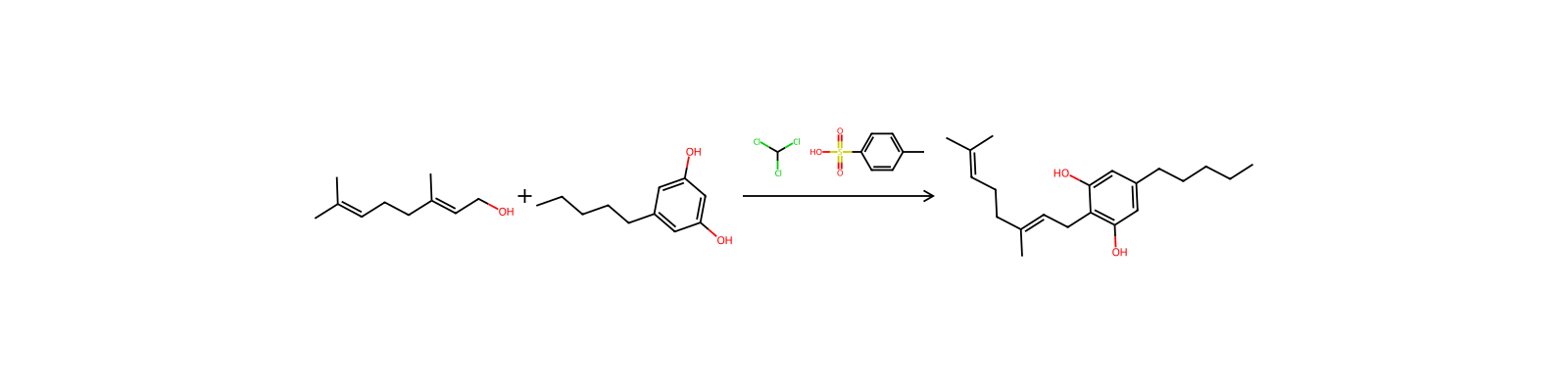
[CH3:1][C:2](=[CH:4][CH2:5][CH2:6]/[C:7](=[CH:9]/[CH2:10]O)/[CH3:8])[CH3:3].[C:12]1([OH:24])[CH:23]=[C:17]([CH2:18][CH2:19][CH2:20][CH2:21][CH3:22])[CH:16]=[C:14]([OH:15])[CH:13]=1>C(Cl)(Cl)Cl.C1(C)C=CC(S(O)(=O)=O)=CC=1>[CH3:8]/[C:7](/[CH2:6][CH2:5][CH:4]=[C:2]([CH3:3])[CH3:1])=[CH:9]\[CH2:10][C:13]1[C:12]([OH:24])=[CH:23][C:17]([CH2:18][CH2:19][CH2:20][CH2:21][CH3:22])=[CH:16][C:14]=1[OH:15]Participants
5
Reactant 2


Product 1

Reagents, catalysts & solvents 2


Procedure
Geraniol (3 g, 0.0194 mol) and olivetol (2 g, 0.0111 mol) were dissolved in 400 mL of chloroform containing 80 mg of p-toluenesulfonic acid as catalyst and the reaction mixture was stirred at room temperature for 12 h in the dark. After 12 hours, the reaction mixture was washed with saturated sodium bicarbonate (400 mL) and then with H2O (400 mL). The chloroform layer was concentrated at 40 C under reduced pressure, and the residue obtained was chromatographed on a 2.0 cm×25 cm silica gel column using benzene (1000 mL) as the eluent to give 1.4 g (0.00442 mol)(39.9%) CBG as product.
Workup
- waitAfter 12 hours
- washthe reaction mixture was washed with saturated sodium bicarbonate (400 mL)
- concentrationThe chloroform layer was concentrated at 40 C under reduced pressure
- customthe residue obtained
- customwas chromatographed on a 2.0 cm×25 cm silica gel column
- customto give 1.4 g (0.00442 mol)(39.9%) CBG as product
Sources & evidence
- ORD record
- ord-2106425fc04048d7bf390819bae276d2
- Source dataset
- uspto-grants-2016_06
- Patent number
- US09359625B2
Reaction notes
Loading…