Lithium Hydroxide → N-(5-bromo-4-fluoro-1H-pyrrolo[2,3-b]pyridin-3-yl)quinoxaline-2-carboxamide
Reaction equation

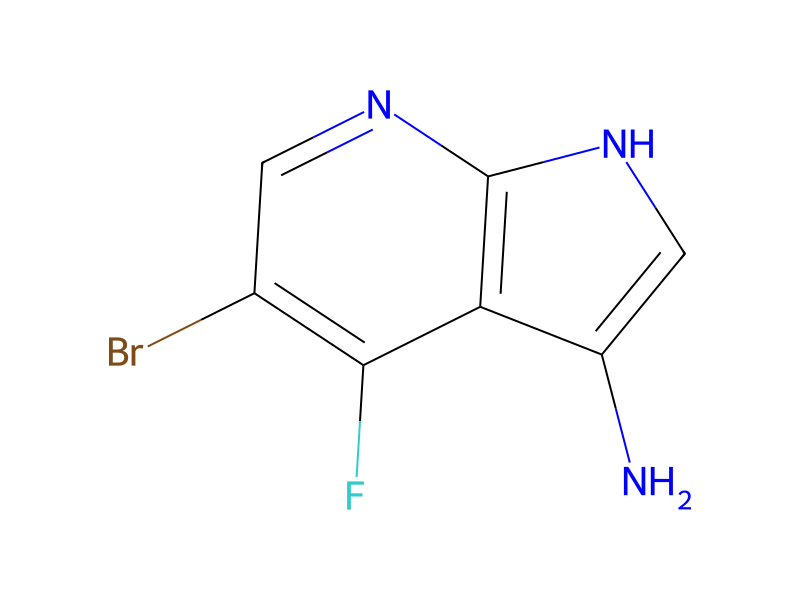
[Br:1][C:2]1[C:3]([F:12])=[C:4]2[C:10]([NH2:11])=[CH:9][NH:8][C:5]2=[N:6][CH:7]=1.[N:13]1[C:22]2[C:17](=[CH:18][CH:19]=[CH:20][CH:21]=2)[N:16]=[CH:15][C:14]=1[C:23](O)=[O:24].C1N(P(Cl)(N2C(=O)OCC2)=O)C(=O)OC1.C(N(CC)CC)C.[Li+].[OH-]>C(Cl)Cl.O>[Br:1][C:2]1[C:3]([F:12])=[C:4]2[C:10]([NH:11][C:23]([C:14]3[CH:15]=[N:16][C:17]4[C:22](=[CH:21][CH:20]=[CH:19][CH:18]=4)[N:13]=3)=[O:24])=[CH:9][NH:8][C:5]2=[N:6][CH:7]=1Participants
8
Reactant 5




Product 1

Reagents, catalysts & solvents 2


Procedure
5-Bromo-4-fluoro-1H-pyrrolo[2,3-b]pyridin-3-amine (0.160 g, 0.696 mmol, Example 1, Step H), quinoxaline-2-carboxylic acid (0.254 g, 1.46 mmol), BOP-Cl (0.372 g, 1.46 mmol), and triethylamine (0.352 g, 3.48 mmol) were placed in DCM (5 mL) at room temperature and stirred for 15 hours. 3M aqueous LiOH (3 mL) was then added, and the reaction was stirred for 10 minutes. Water (10 mL) and DCM (10 mL) were then added, and the reaction was filtered. The resulting solid was slurried with 10:1 DCM:MeOH and filtered to give solid N-(5-bromo-4-fluoro-1H-pyrrolo[2,3-b]pyridin-3-yl)quinoxaline-2-carboxamide (0.240 g, 89% yield).
Workup
- stirringthe reaction was stirred for 10 minutes
- filtrationthe reaction was filtered
- filtrationMeOH and filtered
Sources & evidence
- ORD record
- ord-10c061b2e1d84d49a0cc932c105c23ee
- Source dataset
- uspto-grants-2016_06
- Patent number
- US09365568B2
Reaction notes
Loading…