Sodium t-butoxide → HCID 178419833, compound
Reaction equation
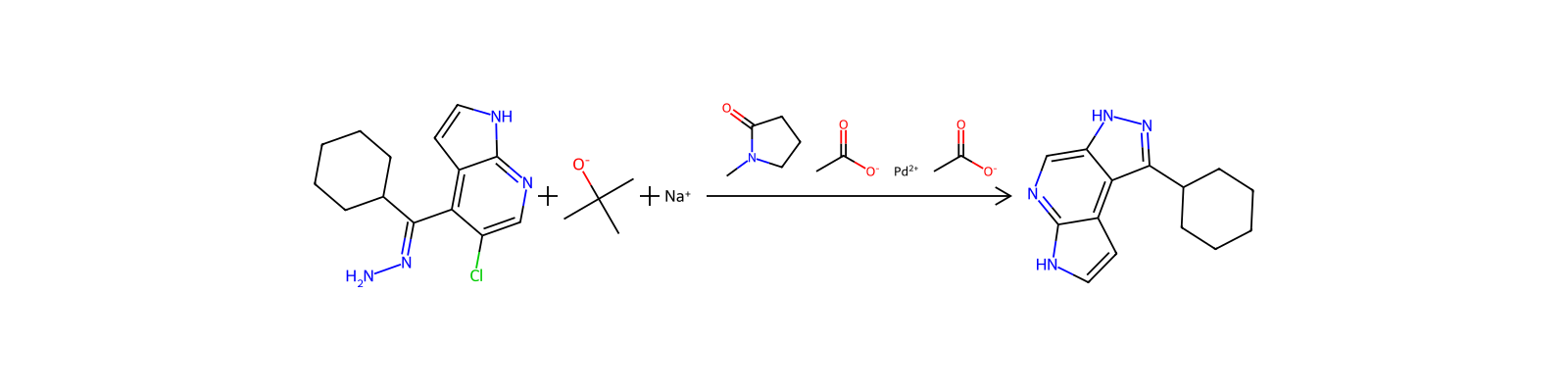
Cl[C:2]1[C:3]([C:11]([CH:14]2[CH2:19][CH2:18][CH2:17][CH2:16][CH2:15]2)=[N:12][NH2:13])=[C:4]2[CH:10]=[CH:9][NH:8][C:5]2=[N:6][CH:7]=1.CC(C)([O-])C.[Na+]>CN1CCCC1=O.C([O-])(=O)C.[Pd+2].C([O-])(=O)C>[CH:14]1([C:11]2[C:3]3=[C:4]4[CH:10]=[CH:9][NH:8][C:5]4=[N:6][CH:7]=[C:2]3[NH:13][N:12]=2)[CH2:19][CH2:18][CH2:17][CH2:16][CH2:15]1Participants
5
Reactant 2


Product 1

Reagents, catalysts & solvents 2


Procedure
A mixture of 5-chloro-4-(cyclohexyl(hydrazono)methyl)-1H-pyrrolo[2,3-b]pyridine (0.125 g, 0.452 mmol), sodium tert-butoxide (0.104 g, 1.08 mmol), palladium acetate (0.001 g, 0.0045 mmol) and (R)-1-[(S)-2-(dicyclohexylphosphino)ferrocenyl]ethyl di-tert-butyl phosphine (0.0025 g, 0.0045 mmol) was heated in N-methyl-2-pyrrolidinone (2 mL) at about 160° C. in a CEM Discover microwave for about 30 min. The insoluble residue was removed by filtration and the filtrate was subjected to purification by preparative RP-HPLC (Table 2, Method h) to yield 1-cyclohexyl-3,6-dihydropyrazolo[4,3-d]pyrrolo[2,3-b]pyridine as a white solid (0.036 g, 33%); LC/MS (Table 2, Method d) Rt=2.04 min; MS m/z: 241 (M+H)+.
Workup
- customThe insoluble residue was removed by filtration
- customthe filtrate was subjected to purification by preparative RP-HPLC (Table 2, Method h)
Sources & evidence
- ORD record
- ord-537f2fa249b74ecc96690b093251e62e
- Source dataset
- uspto-grants-2016_06
- Patent number
- US09365579B2
Reaction notes
Loading…