Propionic Acid → Butyric Acid
Reaction equation

O=C[C@@H]([C@H:5]([C@@H:7]([C@@H:9]([CH2:11][OH:12])O)O)O)O.[C:13]([OH:18])(=[O:17])[C@H:14]([CH3:16])[OH:15].C(O)(=O)CC>C(O)(=O)C>[C:11]([OH:12])(=[O:15])[CH2:9][CH2:7][CH3:5].[C:13]([OH:18])(=[O:17])[CH2:14][CH3:16]Participants
Reactant 3
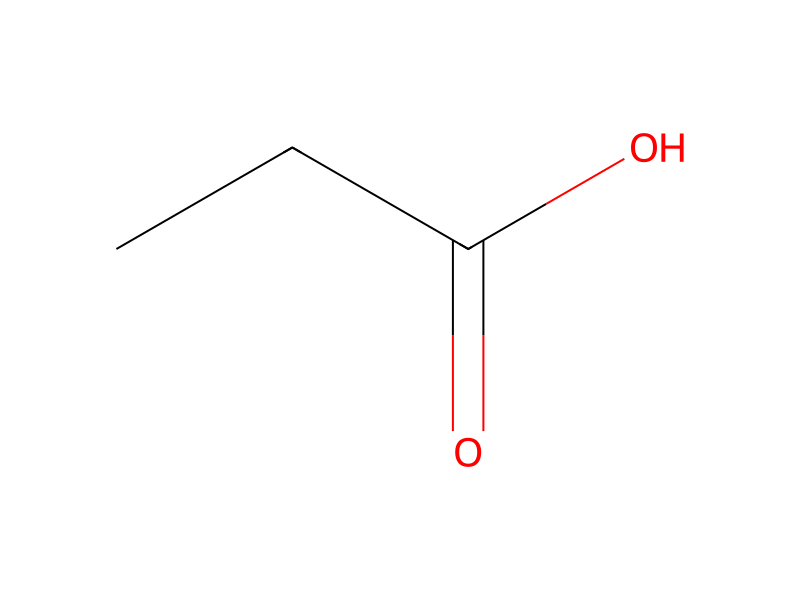


Product 2

Reagents, catalysts & solvents 1

Procedure
When glucose is used as the sole substrate, as in the first experiment, the difference between total carbon yield and butyric carbon yield is greater than when a combination of glucose and L-lactic acid is used, because higher amounts of acetic acid and propionic acid are generated during the fermentation. See FIG. 7. In addition, the butyric carbon yield (61%) is much higher than that of free cell fermentation (see Table 1, 36%), because the immobilized cell beads can be used repeatedly for a long period of time, which may cause cell adaptation to endure higher butyrate concentration, thereby resulting in a higher butyric carbon yield. The second experiment using a feedstock containing both glucose and L-lactic acid affords 69% butyric carbon yield (higher than the theoretical yield), while suppressing the generation of acetic acid and propionic acid (the difference between total carbon yield and butyric carbon yield is only 5%). See FIG. 8. Third, when L-lactic acid is used as the sole substrate, butyric acid is produced in an significant amount, although acetic acid and propionic acid are also generated (the difference between total carbon yield and butyric carbon yield is 23%). See FIG. 9. The total carbon yield, 96%, is very close to the theoretical value (100%). In view of the above, the combination of lactic acid and carbohydrate as substrates in fermentation exceeds those results anticipated under conventional fermentation using glucose as the only substrate, and in some instances may be deemed synergistic with the improvement of the butyric carbon yield.
Workup
- customthe difference between total carbon yield
- custombutyric carbon yield
- customIn addition, the butyric carbon yield (61%)
- waitbecause the immobilized cell beads can be used repeatedly for a long period of time, which
- concentrationbutyrate concentration
- customresulting in a higher butyric carbon
- customyield
- customaffords 69% butyric carbon
- customyield (higher than the
- customtheoretical yield),
- customyield
- custombutyric carbon yield
Sources & evidence
- ORD record
- ord-2a41070f5b8a437e92f5e2d04bb46477
- Source dataset
- uspto-grants-2016_06
- Patent number
- US09371548B2
Reaction notes
Loading…