Triethylamine → 4-Bromo-3,6-dimethyl-pyridine-2-carbonitrile
Reaction equation

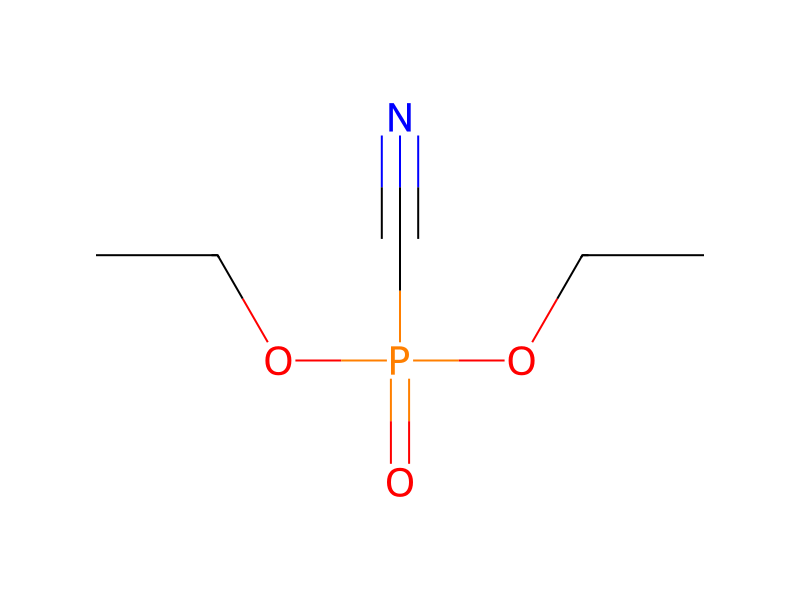
[Br:1][C:2]1[C:7]([CH3:8])=[CH:6][N+:5]([O-])=[C:4]([CH3:10])[CH:3]=1.C(OP([C:19]#[N:20])(OCC)=O)C.C(N(CC)CC)C>CC#N>[Br:1][C:2]1[CH:3]=[C:4]([CH3:10])[N:5]=[C:6]([C:19]#[N:20])[C:7]=1[CH3:8]Participants
5
Reactant 3


Product 1

Reagents, catalysts & solvents 1

Conditions
- Temperature
- 80 °C
Procedure
To a Smith microwave vial was added 4-bromo-2,5-dimethyl-1-oxido-pyridin-1-ium (which may be prepared as described in Description 136), (300 mg, 1.48 mmol), diethoxyphosphorylformonitrile (0.9 mL, 5.94 mmol) and triethylamine (0.41 mL, 2.97 mmol) in anhydrous MeCN (1 mL). The reaction mixture was heated by microwave at 80° C. for 1 h. The reaction mixture was evaporated and the crude dark oil was purified on silica gel chromatography (10 g SiO2) eluting with ethyl acetate in iso-hexane (0-80%). Evaporation of desired fractions gave 4-bromo-3,6-dimethyl-pyridine-2-carbonitrile (D137) (218 mg, 1.0329 mmol, 69.6% yield) as colourless solid;
Workup
- customThe reaction mixture was evaporated
- customthe crude dark oil was purified on silica gel chromatography (10 g SiO2)
- washeluting with ethyl acetate in iso-hexane (0-80%)
- customEvaporation of desired fractions
Sources & evidence
- ORD record
- ord-3e47e9f5b2bd41e3ba40667aa0bfd57a
- Source dataset
- uspto-grants-2016_06
- Patent number
- US09376436B2
Reaction notes
Loading…