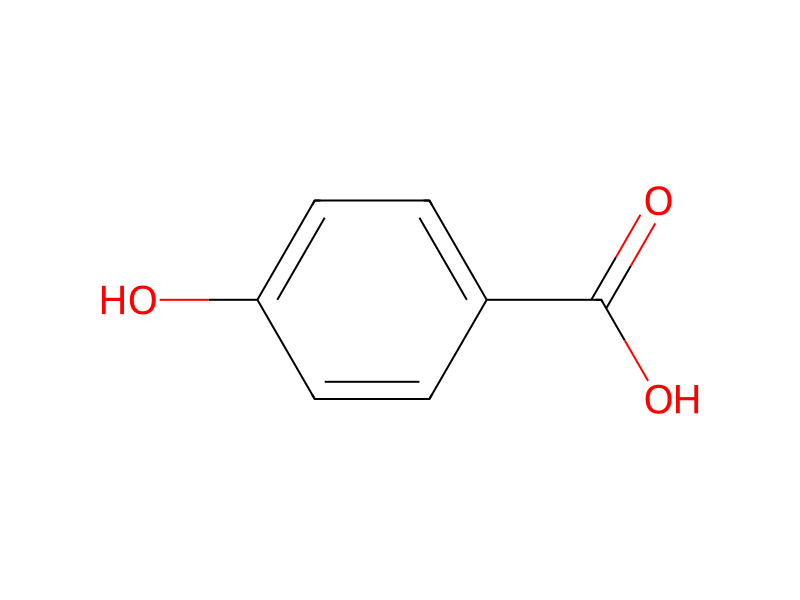
4-Hydroxybenzoic Acid → 4-hydroxy-N,N-bis(propan-2-yl)benzamide
Reaction equation

[OH:1][C:2]1[CH:10]=[CH:9][C:5]([C:6]([OH:8])=O)=[CH:4][CH:3]=1.C(Cl)(=O)C(Cl)=O.CN(C)C=O.[CH:22]([NH:25][CH:26]([CH3:28])[CH3:27])([CH3:24])[CH3:23]>ClCCl>[OH:1][C:2]1[CH:3]=[CH:4][C:5]([C:6]([N:25]([CH:26]([CH3:28])[CH3:27])[CH:22]([CH3:24])[CH3:23])=[O:8])=[CH:9][CH:10]=1Participants
6
Reactant 4



Product 1

Reagents, catalysts & solvents 1

Procedure
A stirred solution of 4-hydroxybenzoic acid (5 g, 36.2 mmol) in 50 mL of dichloromethane is treated at 0° C. with oxalyl chloride (6.3 mL, 72.4 mmol) and N,N-dimethylformamide (5.6 mL, 72.4 mmol). This solution is stirred at room temperature for 2 hours and treated with diisopropylamine (40 mL, 286 mmol) at 0° C. After stirring at room temperature for overnight, the reaction is partitioned between ethyl acetate and 1N hydrochloride solution. The organic phase is washed with brine, dried over sodium sulfate, and concentrated in vacuo to afford 4-hydroxy-N,N-bis(1-methylethyl)benzamide.
Workup
- stirringAfter stirring at room temperature for overnight
- customthe reaction is partitioned between ethyl acetate and 1N hydrochloride solution
- washThe organic phase is washed with brine
- dry with materialdried over sodium sulfate
- concentrationconcentrated in vacuo
Sources & evidence
- ORD record
- ord-89a501b123b5427da8d5d4254818dca5
- Source dataset
- uspto-grants-1995_10
- Patent number
- US05455274
Reaction notes
Loading…