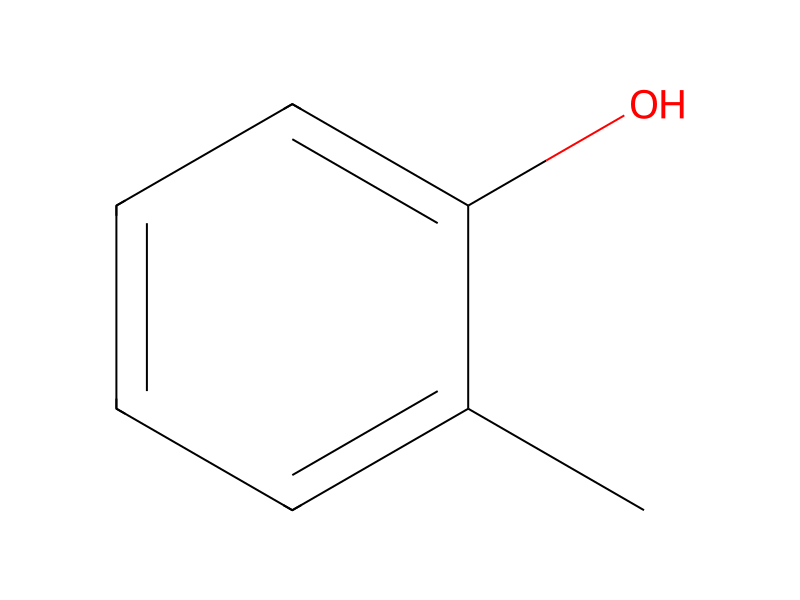
O-Cresol → bis(2-methylphenyl) phosphorochloridate
Reaction equation

[P:1]([Cl:5])(Cl)(Cl)=[O:2].[C:6]1([CH3:13])[C:11]([OH:12])=[CH:10][CH:9]=[CH:8][CH:7]=1>>[P:1]([Cl:5])(=[O:2])([O:12][C:11]1[CH:10]=[CH:9][CH:8]=[CH:7][C:6]=1[CH3:13])[O:12][C:11]1[CH:10]=[CH:9][CH:8]=[CH:7][C:6]=1[CH3:13]Participants


Procedure
While it is known to form compounds of the formula (ArO)2P(O)Cl (see U.S. Pat. No. 3,965,220), only a few disclosures are known to exist in which such polyphosphate compounds are formed in which the initial reaction is between monohydroxy compound and phosphorus oxychloride with the second reaction step using diol as the reagent. In U.S. Pat. No. 4,133,846 it is taught in Example 4 that bis(2-chloroethyl) chlorophosphate and pentaerythritol were to be reacted to form the desired product. Presumably, the bis(2-chloroethyl) chlorophosphate could be formed by reaction of phosphorus oxytrichloride and appropriate monohydroxy compound (i.e., 2-chloroethanol). U.S. Pat. No. 3,254,973, at Col. 5, line 66 and following, illustrates preparation of 4,4'-isopropylidene diphenol bis(di-o-tolylphosphate) by first reacting phosphorus oxychloride with o-cresol to form a reaction mixture in which di-o-tolyl phosphorochloridate cuts are removed by distillation. The di-o-tolyl phosphorochloridate from the first reaction step was then reacted with the diol (i.e., bisphenol A) to make the desired bisphosphate.
Sources & evidence
- ORD record
- ord-d3b46daf7b4c414489e0defd9af31520
- Source dataset
- uspto-grants-1995_10
- Patent number
- US05457221
Reaction notes
Loading…