Bromocyclopentane → 3-Cyclopentyloxy-4-methoxybenzaldehyde
Reaction equation

[O:1]=[CH:2][C:3]1[CH:11]=[CH:10][C:7]([O:8][CH3:9])=[C:5]([OH:6])[CH:4]=1.C([O-])([O-])=O.[K+].[K+].[CH:18]1(Br)[CH2:22][CH2:21][CH2:20][CH2:19]1>CN(C=O)C>[CH:18]1([O:6][C:5]2[CH:4]=[C:3]([CH:11]=[CH:10][C:7]=2[O:8][CH3:9])[CH:2]=[O:1])[CH2:22][CH2:21][CH2:20][CH2:19]1Participants
Reactant 3



Product 1
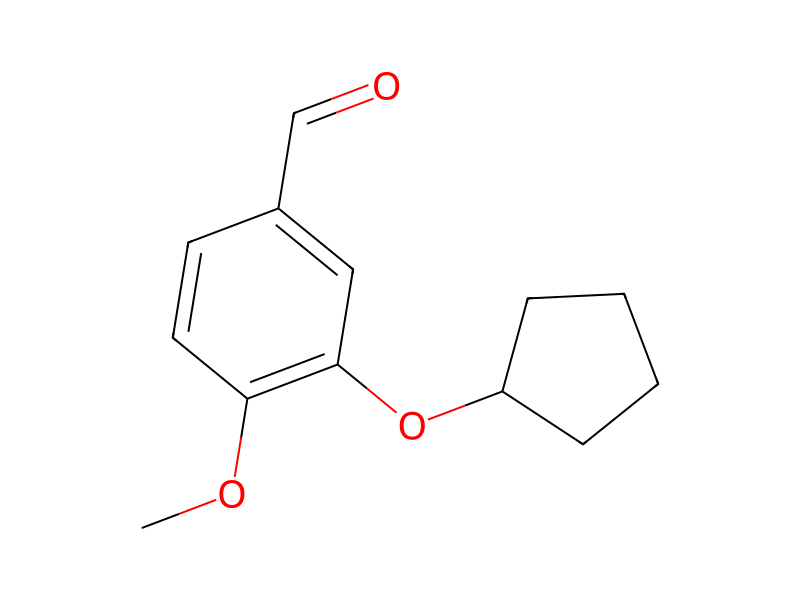
Reagents, catalysts & solvents 1

Conditions
- Temperature
- 60 °C
Procedure
To a magnetically-stirred solution of isovanillin (557 mmol, 85.0 g) in dry DMF (500 mL) at room temperature was added powdered K2CO3 (558 mmol, 77.1 g) in one portion followed by the dropwise addition of neat cyclopentyl bromide (614 mmol, 91.5 g; 65.9 mL). The resulting suspension was warmed to 60° C. and the reaction monitored by TLC until complete. Upon completion, the reaction mixture was cooled to room temperature and the DMF was removed in vacuo. The residue was partitioned between H2O and EtOAc, the aqueous phase extracted with EtOAc and the combined organic layers were washed with H2O. The organics were dried (Na2SO4) and concentrated in vacuo to afford the alkylated product (317 mmol, 70.1 g; 57%) as a viscous oil which was of sufficient purity to be used as such in subsequent transformation.
Workup
- temperatureUpon completion, the reaction mixture was cooled to room temperature
- customthe DMF was removed in vacuo
- customThe residue was partitioned between H2O and EtOAc
- extractionthe aqueous phase extracted with EtOAc
- washthe combined organic layers were washed with H2O
- dry with materialThe organics were dried (Na2SO4)
- concentrationconcentrated in vacuo
- customto afford the alkylated product (317 mmol, 70.1 g; 57%) as a viscous oil which
Sources & evidence
- ORD record
- ord-2b301a8ac81f4312b8e519eac1b20d1e
- Source dataset
- uspto-grants-1995_10
- Patent number
- US05459151
Reaction notes
Loading…