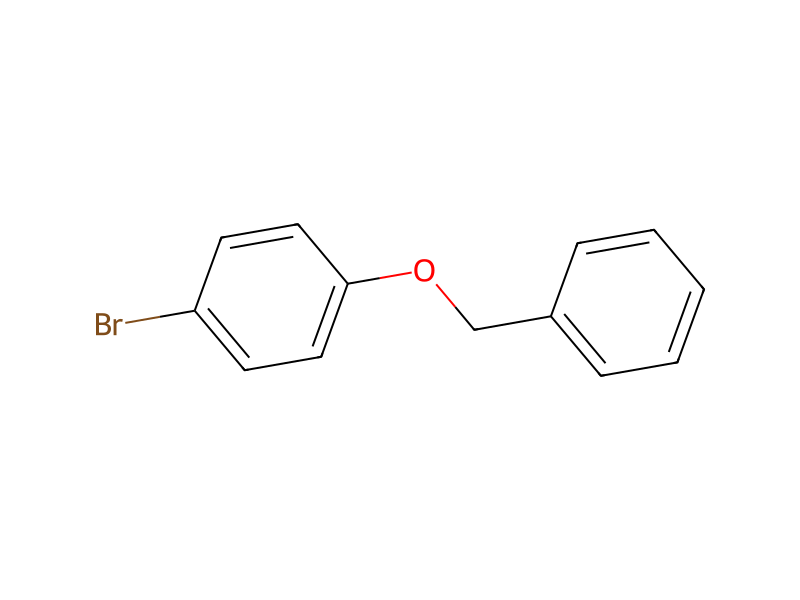
Benzyl Bromide → 1-Bromo-4-phenylmethoxybenzene
Reaction equation

[Br:1][C:2]1[CH:7]=[CH:6][C:5]([OH:8])=[CH:4][CH:3]=1.[CH2:9](Br)[C:10]1[CH:15]=[CH:14][CH:13]=[CH:12][CH:11]=1.C(=O)([O-])[O-].[Cs+].[Cs+]>CS(C)=O>[Br:1][C:2]1[CH:7]=[CH:6][C:5]([O:8][CH2:9][C:10]2[CH:15]=[CH:14][CH:13]=[CH:12][CH:11]=2)=[CH:4][CH:3]=1Participants
5
Reactant 3



Product 1
Reagents, catalysts & solvents 1

Procedure
4-Bromophenol (3.9 g, 22.41 mmol), benzyl bromide (4.6 g, 26.9 mmol), and cesium carbonate (89.6 mmol) were combined in DMSO (30 mL) under nitrogen at room temperature. The reaction was stirred for 24 h, filtered to remove the solids, and then partitioned between ethyl acetate and water. The organic layer was washed with water, 1 N HCl, and brine; dried over magnesium sulfate; and, concentrated to give a semi-solid. The product was crystallized from hexanes to give 1-bromo-4-benzyloxy-benzene as an off white powder (4.3 g, 75%). MS found: (M+H)+=263, 265.
Workup
- filtrationfiltered
- customto remove the solids
- custompartitioned between ethyl acetate and water
- washThe organic layer was washed with water, 1 N HCl, and brine
- dry with materialdried over magnesium sulfate
- concentrationand, concentrated
- customto give a semi-solid
- customThe product was crystallized from hexanes
Sources & evidence
- ORD record
- ord-74dfdb5886494b639626d45b0448131f
- Source dataset
- uspto-grants-2006_09
- Patent number
- US07102008B2
Reaction notes
Loading…