Tetrahydrofuran → 6-(4-Methylphenyl)-1,2,3,4-tetrahydronaphthalene
Reaction equation

C1COCC1.[C:6]1([CH3:14])[CH:11]=[CH:10][C:9]([Mg]Br)=[CH:8][CH:7]=1.C1(P(C2CCCCC2)C2CCCCC2)CCCCC1.CO[C:36]1[CH:37]=[C:38]2[C:43](=[CH:44][CH:45]=1)[CH2:42][CH2:41][CH2:40][CH2:39]2>C(OCOCC)C>[CH3:14][C:6]1[CH:11]=[CH:10][C:9]([C:36]2[CH:37]=[C:38]3[C:43](=[CH:44][CH:45]=2)[CH2:42][CH2:41][CH2:40][CH2:39]3)=[CH:8][CH:7]=1Participants




Procedure
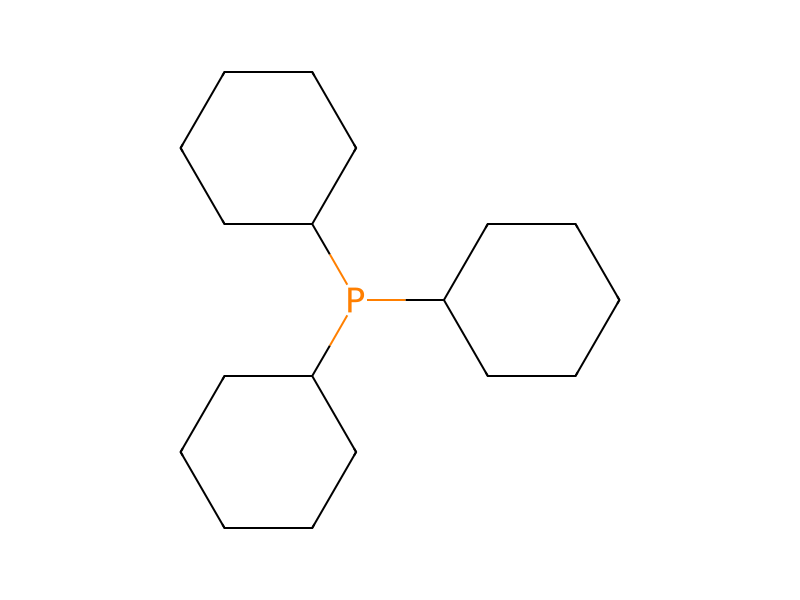
A THF solution of p-tolylmagnesium bromide (20.0 mL, 20.0 mmol) was placed under vacuum to remove the volatiles. The solvent was replaced with diethoxymethane (20.0 mL). In a separate flask, NiCl2(PCy3)2 (where Cy=cyclohexyl) (355 mg, 0.514 mmol), PCy3 (285 mg, 1.018 mmol), and 6-methoxy-1,2,3,4-tetrahydronaphthalene (1.639 g, 10.11 mmol) was combined in diethoxymethane (2.5 mL). The Grignard reagent was added to this mixture under a nitrogen atmosphere. The resulting solution was stirred 2 minutes at room temperature and then warmed to 90° C. for 15 hours. The reaction was quenched with half saturated aqueous ammonium chloride solution (30 mL) and was extracted with MTBE (3×30 mL). The combined organic layer was dried over MgSO4, filtered and concentrated. The residue was purified by silica gel chromatography (eluted with heptane) to provide 6-(4-methylphenyl)-1,2,3,4-tetrahydronaphthalene (1.43 g, 64% yield)
Workup
- customto remove the volatiles
- temperaturewarmed to 90° C. for 15 hours
- customThe reaction was quenched with half saturated aqueous ammonium chloride solution (30 mL)
- extractionwas extracted with MTBE (3×30 mL)
- dry with materialThe combined organic layer was dried over MgSO4
- filtrationfiltered
- concentrationconcentrated
- customThe residue was purified by silica gel chromatography (eluted with heptane)
Sources & evidence
- ORD record
- ord-a13b28035ba04166800a8bf2fb7c9efe
- Source dataset
- uspto-grants-2006_09
- Patent number
- US07105467B2
Reaction notes
Loading…