P-Cresol → 6-(4-Methylphenyl)-1,2,3,4-tetrahydronaphthalene
Reaction equation

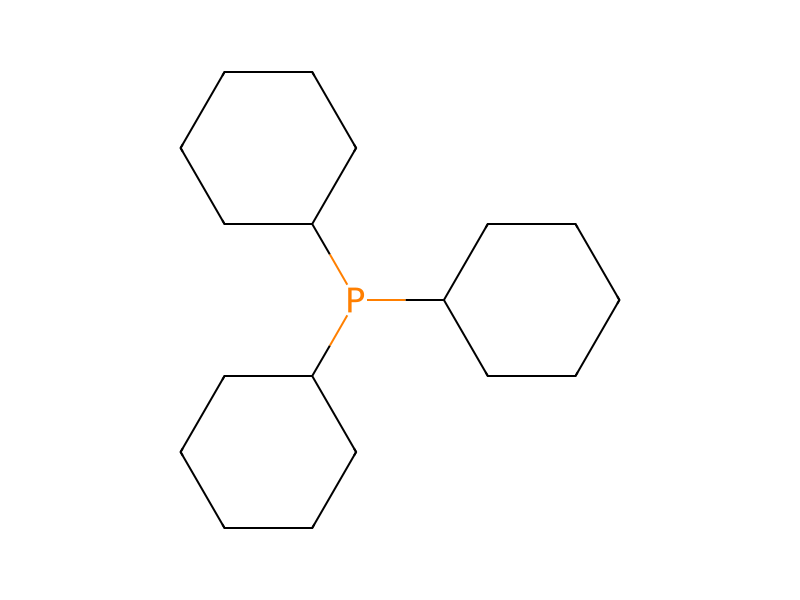
C1(P(C2CCCCC2)C2CCCCC2)CCCCC1.CCCCCC[CH2:26][CH2:27][CH2:28][CH2:29][CH2:30][CH2:31][CH3:32].CN(C)CCO[C:38]1[CH:47]=[CH:46][C:45]2[CH2:44][CH2:43][CH2:42][CH2:41][C:40]=2[CH:39]=1.C(OCOCC)C.C1(C)C(C2C(C)=CC=CC=2)=CC=CC=1.CC1C=CC(O)=CC=1>>[CH3:32][C:31]1[CH:26]=[CH:27][C:28]([C:38]2[CH:39]=[C:40]3[C:45](=[CH:46][CH:47]=2)[CH2:44][CH2:43][CH2:42][CH2:41]3)=[CH:29][CH:30]=1Participants




Procedure
In a reaction flask was placed NiCl2(PCy3)2 (69.0 mg, 0.0999 mmol), PCy3 (57.8 mg, 0.206 mmol), tridecane (328 mg, 1.778 mmol, as an internal standard), and N,N-dimethyl-N-[2-(5,6,7,8-tetrahydronaphthalen-2-yloxy)ethyl]amine (409 mg, 1.867 mmol). The solvent in the Grignard reagent (1 M in ether, 6.0 mmol) was exchanged with diethoxymethane (6.0 mL) and this solution added to the above catalyst mixture under a nitrogen atmosphere at room temperature. The resulting solution was stirred for several minutes at room temperature and then warmed to 95° C. for 15 hours. A sample was withdrawn and quenched with an aqueous sodium citrate solution (1 M) and was extracted with ethyl acetate. GC analysis of the organic phase showed the presence of 6-(4-methylphenyl)-1,2,3,4-tetrahydronaphthalene (1.851 mmol, 99% yield) and bitoluene (0.654 mmol) and p-methylphenol (0.575 mmol) in the reaction mixture.
Workup
- customIn a reaction flask was placed
- additionthis solution added to the above catalyst mixture under a nitrogen atmosphere at room temperature
- temperaturewarmed to 95° C. for 15 hours
- customA sample was withdrawn
- customquenched with an aqueous sodium citrate solution (1 M)
- extractionwas extracted with ethyl acetate
Sources & evidence
- ORD record
- ord-5c6e763fd5844106b8deb70a15f2700c
- Source dataset
- uspto-grants-2006_09
- Patent number
- US07105467B2
Reaction notes
Loading…