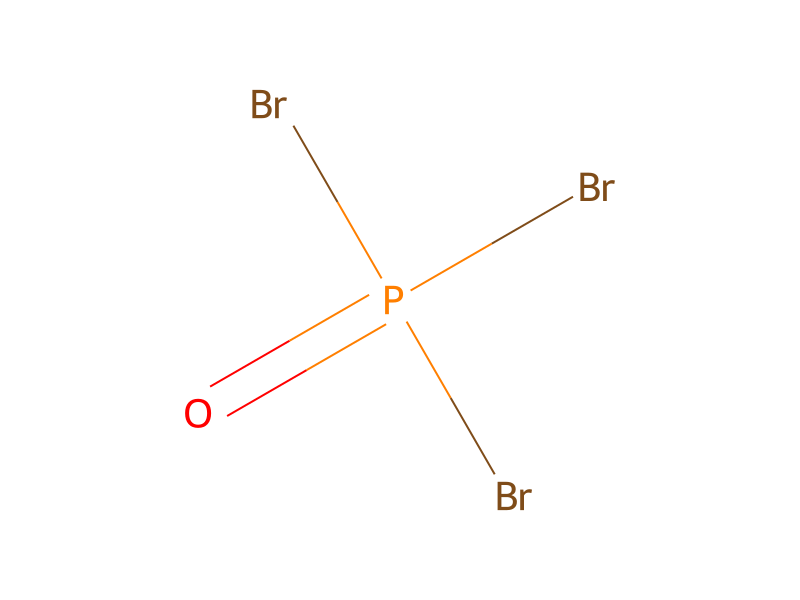
Phosphorus oxybromide → HCID 21946020, compound
Reaction equation

[Cl:1][C:2]1[N:7]=[C:6]([Cl:8])[C:5]([CH:9](O)[CH:10]([CH3:12])[CH3:11])=[CH:4][N:3]=1.C(N(CC)C(C)C)(C)C.P(Br)(Br)([Br:25])=O>BrCBr>[Br:25][CH:9]([C:5]1[C:6]([Cl:8])=[N:7][C:2]([Cl:1])=[N:3][CH:4]=1)[CH:10]([CH3:12])[CH3:11]Participants
Reactant 3


Product 1

Reagents, catalysts & solvents 1

Procedure
(±)-1-(2,4-Dichloro-pyrimidin-5-yl)-2-methyl-propan-1-ol (0.18 g; 0.83 mmol) (from Example 11a supra) was combined with N,N-diisopropyl-ethylamine (0.37 mL; 2.10 mmol) (Aldrich) and a small volume of dibromomethane (50 μL) (Aldrich) to help solubilize the mixture. Only a small amount of material remained insoluble. Neat phosphorus oxybromide (0.22 g; 0.85 mmol) (Aldrich) was added in one portion. Reaction mixture was stirred for 10 minutes and then partitioned between ethyl acetate and water. The organic phase was washed with brine, dried over anhydrous sodium sulfate, filtered and concentrated. Purification by flash chromatography (Biotage 12M) gave (±)-5-(1-bromo-2-methyl-propyl)-2,4-dichloro-pyrimidine as a colorless oil. (Yield 79.5 mg; 33.7%).
Workup
- customReaction mixture
- custompartitioned between ethyl acetate and water
- washThe organic phase was washed with brine
- dry with materialdried over anhydrous sodium sulfate
- filtrationfiltered
- concentrationconcentrated
- customPurification by flash chromatography (Biotage 12M)
Sources & evidence
- ORD record
- ord-0065ed9206114f5cba91504e52eba4df
- Source dataset
- uspto-grants-2006_09
- Patent number
- US07112676B2
Reaction notes
Loading…