Hydrochloric Acid → HCID 11651470, compound
Reaction equation

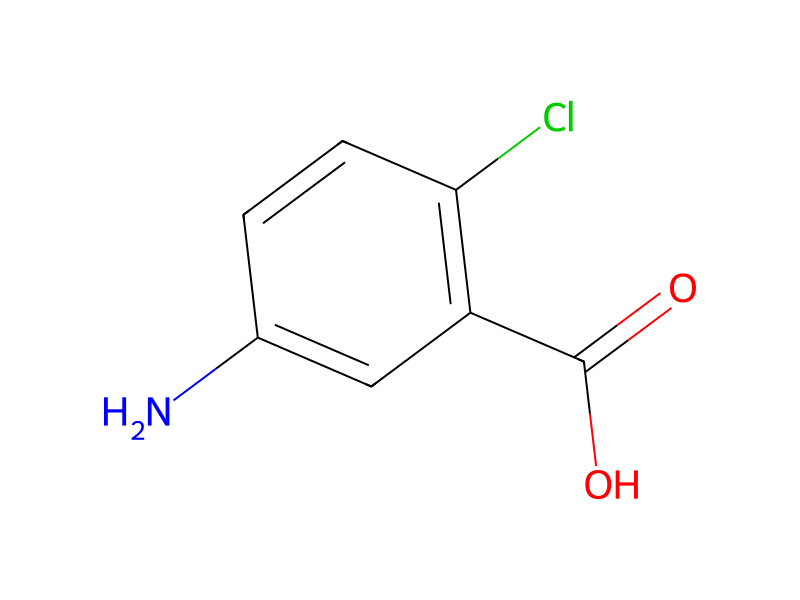
[CH:1](=O)/[CH:2]=[CH:3]/[CH3:4].[NH2:6][C:7]1[CH:8]=[CH:9][C:10]([Cl:16])=[C:11]([CH:15]=1)[C:12]([OH:14])=[O:13].[N+](C1C=C(S([O-])(=O)=O)C=CC=1)([O-])=O.[Na+].Cl>>[Cl:16][C:10]1[CH:9]=[CH:8][C:7]2[N:6]=[C:3]([CH3:4])[CH:2]=[CH:1][C:15]=2[C:11]=1[C:12]([OH:14])=[O:13]Participants




Procedure
Crotonaldehyde (1.5 mL) was added dropwise over a period of 1 hour to a mixture of 5-amino-2-chlorobenzoic acid (1.7 g), ferrous sulphate heptahydrate (0.77 g), sodium m-nitrobenzenesulphonate (1.2 g) and concentrated hydrochloric acid (11 mL) at 95° C. The reaction mixture was heated for a further 15 minutes then filtered whilst still hot. The collected solid was extracted with boiling 2M aqueous hydrochloric acid solution (20 mL) and the extract combined with the filtrate. Ammonium acetate was then added to give a solution of pH 4, which was cooled in ice and the resultant precipitate collected by filtration and washed with water. The product was converted to its hydrochloride salt by treatment with hydrochloric acid (4M in 1,4-dioxane) and the solid dried in vacuo to give the sub-title compound (0.5 g) as a solid.
Workup
- temperatureThe reaction mixture was heated for a further 15 minutes
- filtrationthen filtered whilst still hot
- extractionThe collected solid was extracted
- additionAmmonium acetate was then added
- customto give a solution of pH 4, which
- temperaturewas cooled in ice
- filtrationthe resultant precipitate collected by filtration
- washwashed with water
- customthe solid dried in vacuo
Sources & evidence
- ORD record
- ord-53ab5449d8d24b06ae0251e3d87ed4d1
- Source dataset
- uspto-grants-2008_08
- Patent number
- US07408065B2
Reaction notes
Loading…