Triethylamine → 2-(Trimethylsilyl)ethyl 3-bromo-2-thiophenecarboxylate
Reaction equation

[Br:1][C:2]1[CH:6]=[CH:5][S:4][C:3]=1[C:7]([OH:9])=[O:8].O=S(Cl)Cl.C(N(CC)CC)C.[CH3:21][Si:22]([CH3:27])([CH3:26])[CH2:23][CH2:24]O>ClC(Cl)C>[Br:1][C:2]1[CH:6]=[CH:5][S:4][C:3]=1[C:7]([O:9][CH2:24][CH2:23][Si:22]([CH3:27])([CH3:26])[CH3:21])=[O:8]Participants
6



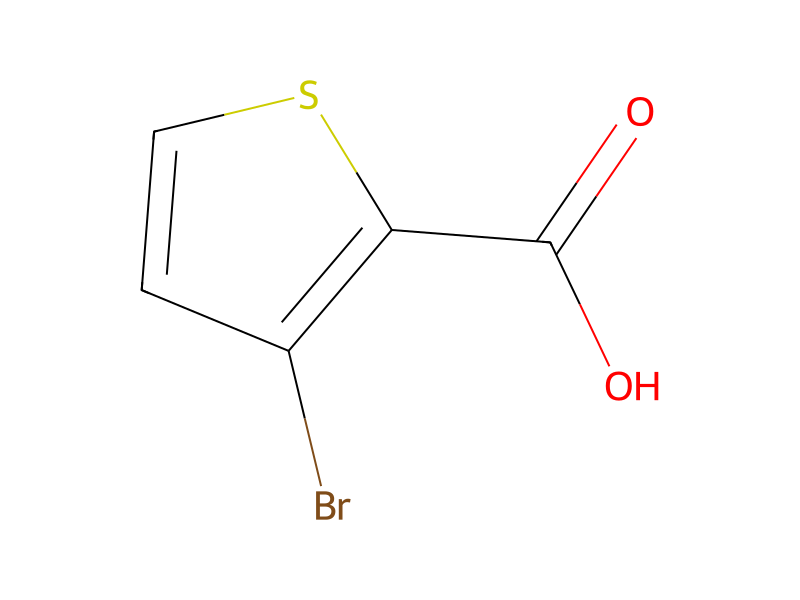


Procedure
A solution of 3-bromothiophene-2-carboxylic acid (1 mmol) and SOCl2 (3 mmol) in 1 mL of dichloroethane was heated at 80° C. for 20 h and then the solvents evaporated. The residue was dissolved in 2 mL CH2Cl2 and mixed with triethylamine (3 mmol) and 2-(trimethylsilyl)ethanol (1.3 mmol) at rt for 12 h. Extractive isolation provided 2-(trimethylsilyl)ethyl 3-bromo-2-thiophenecarboxylate as an oil.
Workup
- customthe solvents evaporated
- dissolutionThe residue was dissolved in 2 mL CH2Cl2
Sources & evidence
- ORD record
- ord-e9fb06033bae4d0a941edf989db7e02b
- Source dataset
- uspto-grants-2008_05
- Patent number
- US07371739B2
Reaction notes
Loading…