4-Nitrophenol → 1-(3-Methylbutoxy)-4-nitrobenzene
Reaction equation

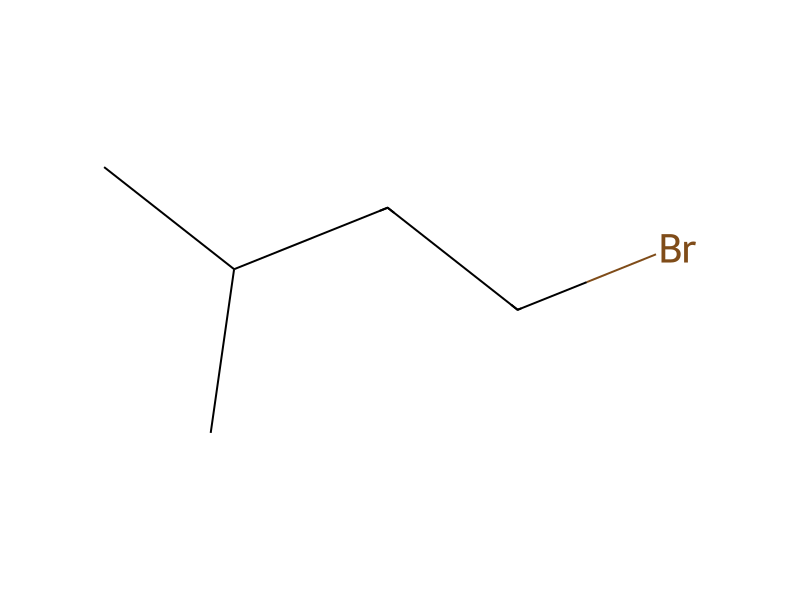
Br[CH2:2][CH2:3][CH:4]([CH3:6])[CH3:5].[N+:7]([C:10]1[CH:15]=[CH:14][C:13]([OH:16])=[CH:12][CH:11]=1)([O-:9])=[O:8].C(=O)([O-])[O-].[K+].[K+]>CN(C)C=O>[CH3:5][CH:4]([CH3:6])[CH2:3][CH2:2][O:16][C:13]1[CH:14]=[CH:15][C:10]([N+:7]([O-:9])=[O:8])=[CH:11][CH:12]=1Participants
Reactant 3


Product 1

Reagents, catalysts & solvents 1

Procedure
1-Bromo-3-methylbutane (7.07 g, 5.60 mL, 46.8 mmol) was added in one portion to a stirred suspension of 4-nitrophenol (5.00 g, 35.9 mmol) and potassium carbonate (5.46 g, 49.5 mmol) in dimethylformamide (50 mL) at room temperature under a nitrogen atmosphere. The resulting mixture was stirred at room temperature for 16 h then the volatiles were evaporated. The residue was partitioned between diethyl ether (50 mL) and water (50 mL) and the phases separated. The aqueous phase was extracted with ether (2×50 mL) then the organic extracts were combined and dried (magnesium sulfate). The solvent was evaporated and the residue chromatographed on silica gel (10% diethyl ether:cyclohexane) to give the title compound as a pale yellow oil (6.63 g, 88%). LC/MS: 3.69 min. 1H NMR (400 MHz; CDCl3): 0.95 (6H), 1.75 (2H), 1.85 (1H), 4.05 (2H), 6.95 (2H), 8.20 (2H).
Workup
- customthe volatiles were evaporated
- customThe residue was partitioned between diethyl ether (50 mL) and water (50 mL)
- customthe phases separated
- extractionThe aqueous phase was extracted with ether (2×50 mL)
- dry with materialdried (magnesium sulfate)
- customThe solvent was evaporated
- customthe residue chromatographed on silica gel (10% diethyl ether:cyclohexane)
Sources & evidence
- ORD record
- ord-3543c9d93d6543f4be95084dd362cf4d
- Source dataset
- uspto-grants-2008_05
- Patent number
- US07375248B2
Reaction notes
Loading…