Sodium Cyanide → 1-Naphthalenecarbonitrile, 3,4-dihydro-6-methoxy-
Reaction equation

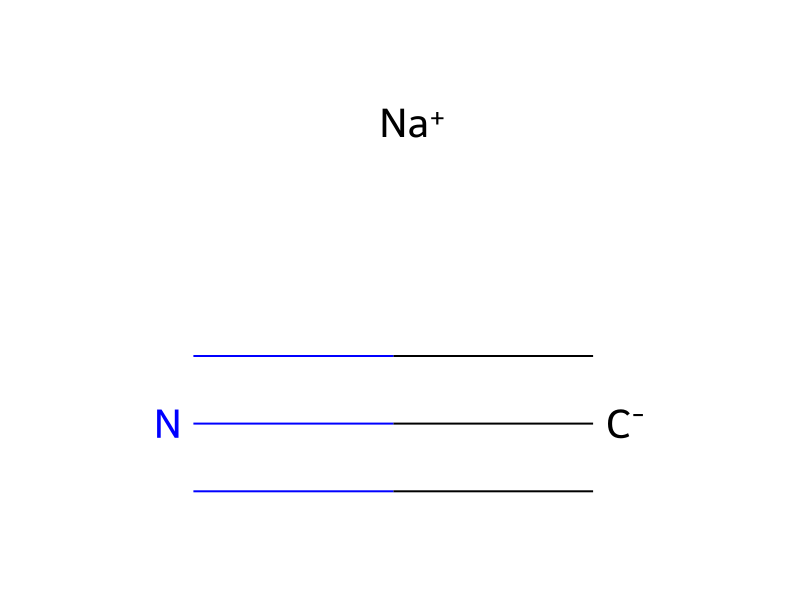
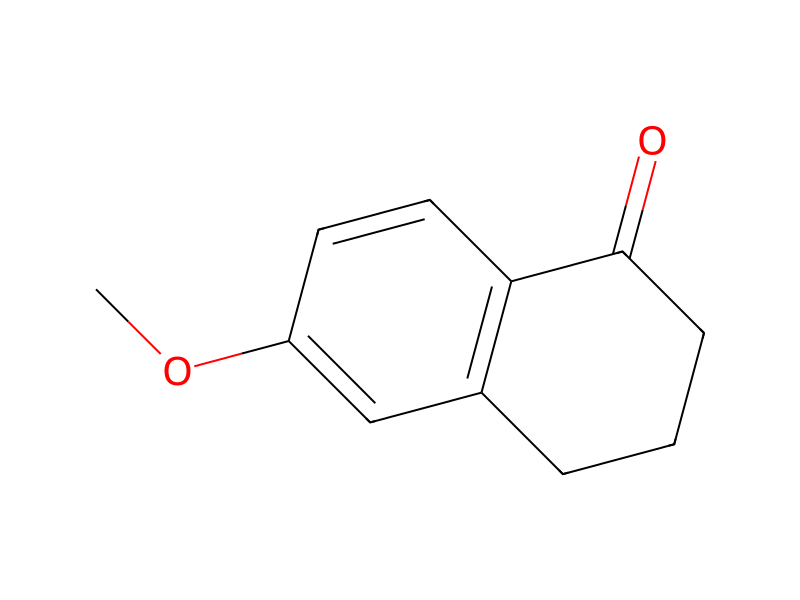
[Cl-].[Al+3].[Cl-].[Cl-].[C-:5]#[N:6].[Na+].[CH3:8][O:9][C:10]1[CH:11]=[C:12]2[C:17](=[CH:18][CH:19]=1)[C:16](=O)[CH2:15][CH2:14][CH2:13]2>[Br-].C([N+](CCCC)(CCCC)CCCC)CCC.Cl.[N+](C1C=CC=CC=1)([O-])=O>[CH3:8][O:9][C:10]1[CH:11]=[C:12]2[C:17](=[CH:18][CH:19]=1)[C:16]([C:5]#[N:6])=[CH:15][CH2:14][CH2:13]2Participants
Reactant 3

Product 1

Reagents, catalysts & solvents 3



Procedure
A mixture of 25.25 g of dry aluminum chloride, 16.7 g of sodium cyanide, 1.7 g of tetrabutylammonium bromide, and 20 drops of concentrated HCl in 170 mL of nitrobenzene was stirred for two hours under a nitrogen atmosphere. Then 30 g of 6-methoxytetralone was added, and the reaction mixture was stirred at 90° C. for six hours to form 6-methoxy-1-cyano-3,4-dihydronaphthalene. A 200-mL portion of 20% NaOH was added, and the reaction mixture became warm and was stirred vigorously at 60° C. for one hour. The phases were allowed to separate. After the nitrobenzene phase had been transferred to another vessel, 35 g of bromine was slowly added and a precipitate formed. The reaction mixture was then heated to remove any HBr, cooled, and worked up to provide 28 g of 6-methoxy-5-bromo-1-cyanonaphthalene.
Workup
- stirringthe reaction mixture was stirred at 90° C. for six hours
Sources & evidence
- ORD record
- ord-47ba11716a834e7799b3a95715f1e9f6
- Source dataset
- uspto-grants-1988_11
- Patent number
- US04785131
Reaction notes
Loading…