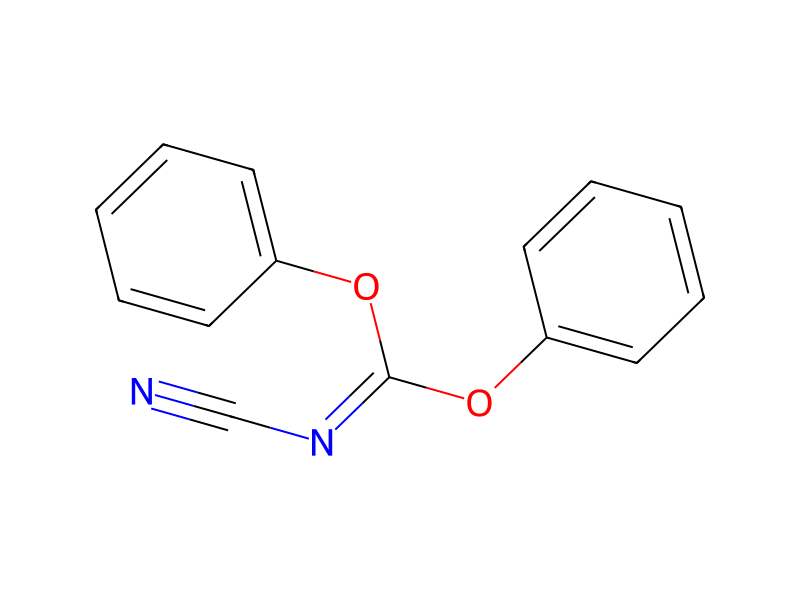
Diphenyl N-Cyanocarbonimidate → HCID 178512285, compound
Reaction equation

C1C=CC(O[C:8]([O:12][C:13]2[CH:18]=[CH:17][CH:16]=[CH:15][CH:14]=2)=[N:9][C:10]#[N:11])=CC=1.[N:19]1([CH2:24][CH2:25][O:26][C:27]2[CH:33]=[CH:32][C:30]([NH2:31])=[CH:29][CH:28]=2)[CH2:23][CH2:22][CH2:21][CH2:20]1>C(O)(C)C>[C:10](/[N:9]=[C:8](\[O:12][C:13]1[CH:14]=[CH:15][CH:16]=[CH:17][CH:18]=1)/[NH:31][C:30]1[CH:32]=[CH:33][C:27]([O:26][CH2:25][CH2:24][N:19]2[CH2:23][CH2:22][CH2:21][CH2:20]2)=[CH:28][CH:29]=1)#[N:11]Participants
Reactant 2

Product 1

Reagents, catalysts & solvents 1

Procedure
Diphenylcyanocarbonimidate (1.1 equiv) and 4-(2-(pyrrolidin-1-yl)ethoxy)aniline (1 equiv) were stirred in iso-propyl alcohol at ambient temperature overnight. The resulting white precipitate was filtered and washed with iso-propyl alcohol and dried to yield (Z)-phenyl N′-cyano-N-(4-(2-(pyrrolidin-1-yl)ethoxy)phenyl)carbamimidate. 3-Hydrazino-6,7-dihydro-5H-benzo[6,7]cyclohepta[1,2-c]pyridazine (82 mg, 0.36 mMol) and (Z)-phenyl N′-cyano-N-(4-(2-(pyrrolidin-1-yl)ethoxy)phenyl)carbamimidate (128 mg, 0.36 mMol) were suspended in isopropanol (3 mL) and subjected to microwave irradiation (150° C., 20 min). The precipitate which formed in the microwave vial was re-dissolved in hot isopropanol. The mixture was cooled to ambient temperature and then filtered to give 1-(6,7-dihydro-5H-benzo[6,7]cyclohepta[1,2-c]pyridazin-3-yl)-N3-(4-(2-(pyrrolidin-1-yl)ethoxy)phenyl)-1H-1,2,4-triazole-3,5-diamine, compound #1, as a yellow solid, 23 mg. 1H NMR (CDCl3, 300 MHz) 7.90 (s, 1H), 7.83 (t, 1H), 7.43 (m, 3H), 7.29 (t, 1H), 6.93 (d, 1H), 6.83 (br s, 2H), 6.39 (s, 1H), 4.17 (m, 2H), 2.98 (m, 2H), 2.60-2.80 (m, 8H), 2.32 (m, 2H), 1.87 (m, 4H) ppm; MS (ES) 483.16 (M+H).
Workup
- filtrationThe resulting white precipitate was filtered
- washwashed with iso-propyl alcohol
- customdried
Sources & evidence
- ORD record
- ord-9cd49a57003c4f4cb6e516f3c5c1a877
- Source dataset
- uspto-grants-2010_05
- Patent number
- US07709482B2
Reaction notes
Loading…