2-Chloro-5-nitropyridine → 2-(3,3-Difluoroazetidin-1-yl)-5-nitropyridine
Reaction equation

Cl[C:2]1[CH:7]=[CH:6][C:5]([N+:8]([O-:10])=[O:9])=[CH:4][N:3]=1.Cl.[F:12][C:13]1([F:17])[CH2:16][NH:15][CH2:14]1.C(N(C(C)C)CC)(C)C>C1COCC1>[N+:8]([C:5]1[CH:6]=[CH:7][C:2]([N:15]2[CH2:16][C:13]([F:17])([F:12])[CH2:14]2)=[N:3][CH:4]=1)([O-:10])=[O:9]Participants
5
Reactant 3


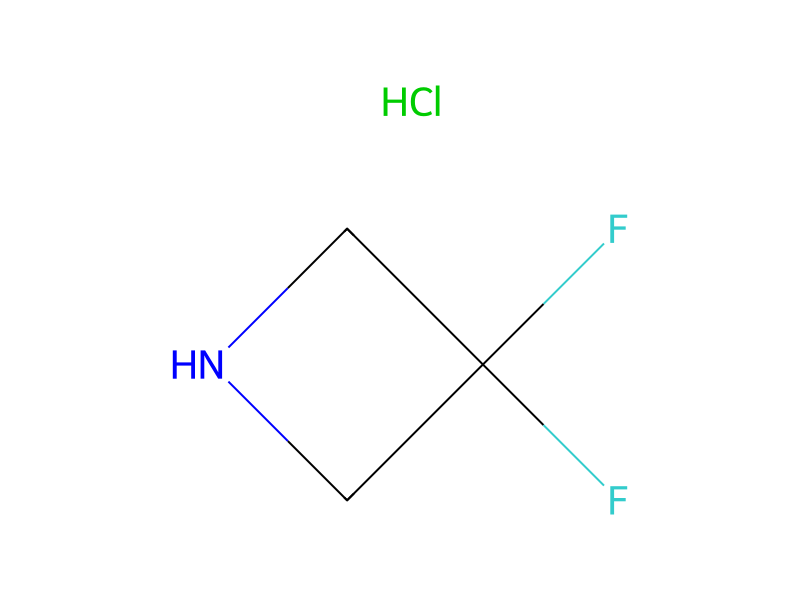
Product 1

Reagents, catalysts & solvents 1

Conditions
- Temperature
- 120 °C
Procedure
The 2-chloro-5-nitro-pyridine (317 mg, 2 mmol) and 3,3-difluoroazetidine hydrochloride (259 mg, 2 mmol) was mixed in 8 mL of THF. Diisopropylethylamine (1.4 mL) was added and the mixture was heated in a microwave at 120° C. for 20 minutes. After cooling to room temperature, the solid was filtered and the filtrate was distributed between ethyl acetate and water. The organic layers were evaporated and the solid material was triturated with methanol. The resulting solid was filtered to give 5-nitro-2-(3,3-difluoroazetidin-1-yl)pyridine. LCMS calcd for C8H7F2N3O2 m/e 215.16, obsd 216.1 (ES, M+H). Hydrogenation of the nitro compound, as above, provided 3-amino-6-(3,3-difluoroazetidin-1-yl)pyridine.
Workup
- temperatureAfter cooling to room temperature
- filtrationthe solid was filtered
- customThe organic layers were evaporated
- customthe solid material was triturated with methanol
- filtrationThe resulting solid was filtered
Sources & evidence
- ORD record
- ord-c8aec9feb60e4993a7288baa9f8a0b52
- Source dataset
- uspto-grants-2010_05
- Patent number
- US07714126B2
Reaction notes
Loading…