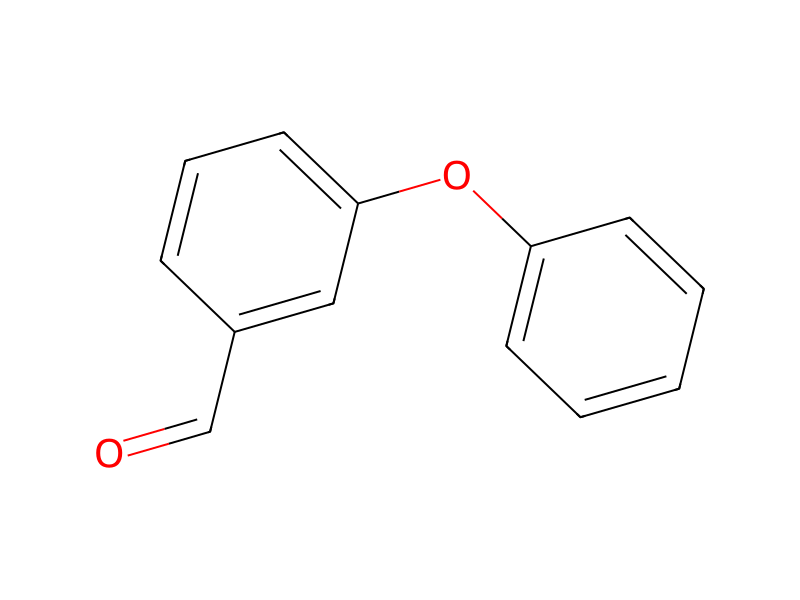
Hydrochloric Acid → 3-Phenoxybenzaldehyde
Reaction equation

Cl.[OH2:2].[O:3]([C:10]1[CH:11]=[C:12]([CH:19]=[CH:20][CH:21]=1)[CH:13]=NCC(C)C)[C:4]1[CH:9]=[CH:8][CH:7]=[CH:6][CH:5]=1>C1(C)C=CC=CC=1>[O:3]([C:10]1[CH:11]=[C:12]([CH:19]=[CH:20][CH:21]=1)[CH:13]=[O:2])[C:4]1[CH:9]=[CH:8][CH:7]=[CH:6][CH:5]=1Participants
5
Reactant 3



Product 1
Reagents, catalysts & solvents 1

Procedure
20 g of 37% hydrochloric acid (about 0.2 mol) and 20 ml of water are added, with stirring, to a solution of 40 g (0.158 mol) of 3-phenoxybenzylidene-isobutylamine in 40 ml of toluene, and the whole is refluxed for 15 minutes. The organic phase is separated; it is then washed neutral with 10% sodium hydrogen carbonate solution, and the toluene is removed by rotation in a slight water-jet vacuum. Distillation of the residue yields 29.7 g (0.15 mol) of 3-phenoxybenzaldehyde, corresponding to a yield of 94.9% of theory; b.p. 94° C./6 Pa; nD20 =1.5976.
Workup
- temperaturethe whole is refluxed for 15 minutes
- customThe organic phase is separated
- washit is then washed neutral with 10% sodium hydrogen carbonate solution
- customthe toluene is removed by rotation in a slight water-jet vacuum
- distillationDistillation of the residue
Sources & evidence
- ORD record
- ord-2e0fa9313051494aba91e78764bf09e3
- Source dataset
- uspto-grants-1980_11
- Patent number
- US04231962
Reaction notes
Loading…