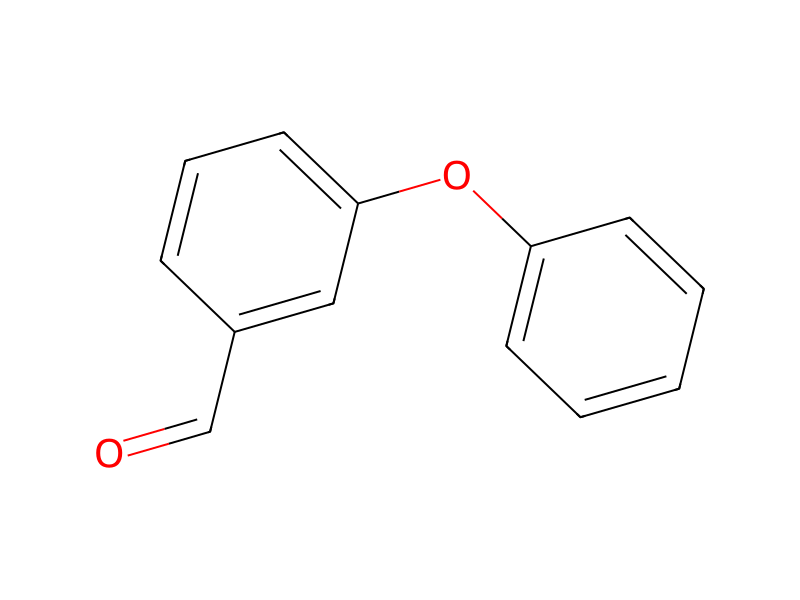
Hydrochloric Acid → 3-Phenoxybenzaldehyde
Reaction equation

C(=N[CH2:6][C:7]1[CH:12]=[CH:11][CH:10]=[C:9]([O:13][C:14]2[CH:19]=[CH:18][CH:17]=[CH:16][CH:15]=2)[CH:8]=1)C(C)C.Cl.[OH2:21]>C1(C)C=CC=CC=1>[O:13]([C:9]1[CH:8]=[C:7]([CH:12]=[CH:11][CH:10]=1)[CH:6]=[O:21])[C:14]1[CH:19]=[CH:18][CH:17]=[CH:16][CH:15]=1Participants
5
Reactant 3



Product 1
Reagents, catalysts & solvents 1

Procedure
80 g (0.316 mol) of N-isobutylidene-3-phenoxybenzylamine is dissolved in 80 ml of toluene; to the solution is then added 4 g (0.036 mol) of potassium-tert-butylate, and the mixture is refluxed for 4 hours. After cooling of the reaction mixture, 35 g of 37% hydrochloric acid (about 0.35 mol) and 50 ml of water are added, and the toluene phase is separated. The toluene is distilled off to leave 57 g (0.288 mol) of 3-phenoxybenzaldehyde, corresponding to a yield of 91% of theory.
Workup
- temperaturethe mixture is refluxed for 4 hours
- additionare added
- customthe toluene phase is separated
- distillationThe toluene is distilled off
Sources & evidence
- ORD record
- ord-03882bbd81f54526ba2b2fb45eaa77e6
- Source dataset
- uspto-grants-1980_11
- Patent number
- US04231962
Reaction notes
Loading…