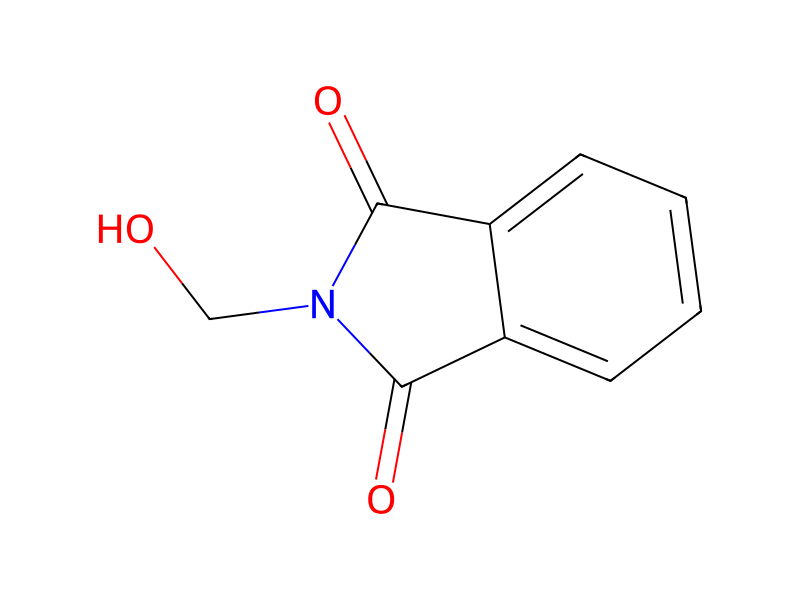
Formaldehyde → N-(hydroxymethyl)phthalimide
Reaction equation

[C:1]1(=[O:11])[NH:5][C:4](=[O:6])[C:3]2=[CH:7][CH:8]=[CH:9][CH:10]=[C:2]12.[CH2:12]=[O:13]>ClCCCl>[CH2:12]([N:5]1[C:1](=[O:11])[C:2]2=[CH:10][CH:9]=[CH:8][CH:7]=[C:3]2[C:4]1=[O:6])[OH:13]Participants


Reagents, catalysts & solvents 1

Procedure
Heterodisperse gel-type or macroporous anion exchangers are obtained, for example, by the phthalimide process according to U.S. Pat. No. 4,952,608, the contents of which are incorporated into the present application by reference. In this process, for example, phthalimide and formalin in 1,2-dichloroethane are first introduced and reacted to form N-methylolphthalimide. From this is produced bis(phthalimidomethyl) ether. First oleum, then polystyrene polymer beads crosslinked at 5% by weight are introduced. The suspension is heated to 70° C. and stirred for a further 18 hours. Dichloroethane is removed from the system by distillation. The resultant polymer beads are taken up in water, sodium hydroxide solution is added and the mixture is treated for 8 hours at 180° C. After they are cooled, the resultant aminomethylated polymer beads are extracted with water by washing.
Workup
- customreacted
Sources & evidence
- ORD record
- ord-b71275e7a2754716a2e71e6da0496385
- Source dataset
- uspto-grants-2010_03
- Patent number
- US07678865B2
Reaction notes
Loading…