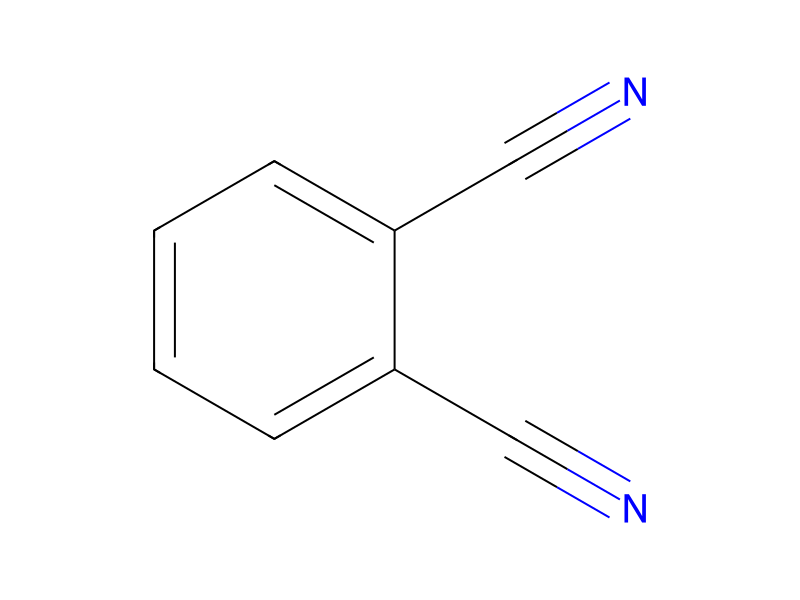
Phthalonitrile → Dichlorotitanium phthalocyanine
Reaction equation

[Ti:1](Cl)(Cl)([Cl:3])[Cl:2].[CH:6]1[CH:11]=[C:10]([C:12]#[N:13])[C:9]([C:14]#[N:15])=[CH:8][CH:7]=1>ClC1C2C(=CC=CC=2)C=CC=1>[Cl:2][Ti:1][Cl:3].[CH:6]1[CH:7]=[CH:8][C:9]2[C:10](=[C:12]3[N:13]=[C:12]4[N:15]=[C:14]([C:9]5[CH:8]=[CH:7][CH:6]=[CH:11][C:10]=54)[N:15]=[C:14]4[NH:13][C:12]([C:10]5[CH:11]=[CH:6][CH:7]=[CH:8][C:9]=54)=[N:15][C:14]4=[N:13][C:12]([C:10]5[CH:11]=[CH:6][CH:7]=[CH:8][C:9]=54)=[N:15][C:14]=2[NH:13]3)[CH:11]=1Participants
4
Reactant 2

Product 1

Reagents, catalysts & solvents 1

Conditions
- Temperature
- 250 °C
Procedure
Titanium tetrachloride (18 g) was added dropwise to a mixture of phthalodinitrile (40 g) and α-chloronaphthalene (500 ml) in a nitrogen stream. Thereafter, the reaction mixture was slowly heated to 250° C., at which it was stirred for 3 h to complete the reaction. Subsequently, the reaction mixture was left to cool to room temperature and filtered to obtain dichlorotitanium phthalocyanine as the reaction product. The dichlorotitanium phthalocyanine thus obtained was hydrolyzed with 300 ml of concentrated aqueous ammonia and thereafter washed with acetone to obtain TiOPc.
Workup
- customthe reaction
- waitSubsequently, the reaction mixture was left
- temperatureto cool to room temperature
- filtrationfiltered
Sources & evidence
- ORD record
- ord-c069a6c407524c5ca14dc97259c1791a
- Source dataset
- uspto-grants-1991_08
- Patent number
- US05039586
Reaction notes
Loading…