Ammonium → 2,6-Xylyl isothiocyanate
Reaction equation

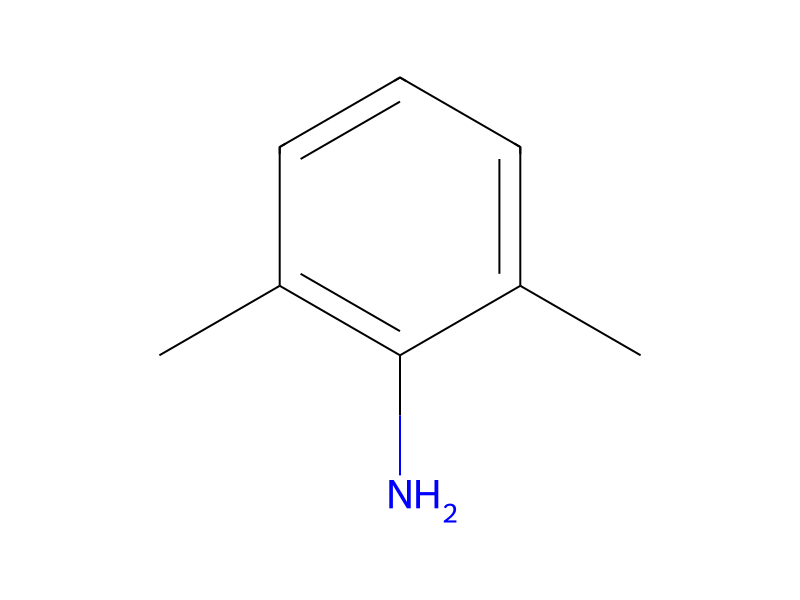
[OH-].[NH4+].[CH3:3][C:4]1[CH:10]=[CH:9][CH:8]=[C:7]([CH3:11])[C:5]=1[NH2:6].[NH4+].[C:13](=S)([S-:15])N.ClC(OCC)=O>O.C(=S)=S>[CH3:3][C:4]1[CH:10]=[CH:9][CH:8]=[C:7]([CH3:11])[C:5]=1[N:6]=[C:13]=[S:15]Participants







Conditions
- Temperature
- 0 °C
Procedure
745 grams (9.8 moles) of carbon disulfide and 1230 milliliters (ml) of concentrated ammonium hydroxide was added to a 5 liter, 3-neck flask fitted with a mechanical stirrer, teflon clad thermocouple, and an additional funnel. The contents of the flask were cooled to 0° C. by use of an ice bath. Then with rapid stirring, 1,008 grams of 2,6-dimethylaniline was added drop wise to the contents of the flask. The temperature was maintained below 10° C. by controlling the rate of addition. It is preferable to maintain the temperature in the range of about 10° C. to avoid a run away reaction (which run away begins to occur at a temperature of about 30° C. and is accompanied by a loss of ammonium (NH3) and carbon disulfide (CS2) gas). The addition took approximately 45 minutes. The reaction mixture (orange-red in color) was allowed to stir for an additional four hours, during which time a dithiocarbamate salt crystalized. The salt crystals were collected by suction filtration using a Buchner funnel, and were allowed to suck dry on the aspirator. The crystaline salt was placed in a 12-L flask fitted with a mechanical stir, thermo couple, and an addition funnel, and 5 liters of water with 2-propanol (water to propanol ratio of which ranged between 1:1 and 3:1 by volume, respectively) was added. Ethyl chloroformate (890.8 grams; 8.21 moles) was added dropwise to the stirred slurry at a rate such that the temperature did not rise above 40° C.; a cooling bath was used to help control the temperature. The addition funnel was replaced by a condenser, and the reaction mixture was heated to between 60° and 70° C. and maintained at this temperature for 1 hour. The reaction mixture was cooled to ambient temperature and then 1 liter of water was added. The layers were separated, and the bottom layer (2,6-dimethylphenylisothiocyanate) was washed with 200 ml of water and then dryed over anhydrous sodium sulfate. Distillation under vaccuum (125° Centigrade at about 3 torr.) gave 949 grams (55.2% yield on total theoretical basis by weight) of 2,6-dimethylphenylisothiocyanate. The intermediate product is filtered to remove any solid by-product prior to use in next step. The product was used directly in the next step of the synthesis.
Workup
- customfitted with a mechanical stirrer
- temperatureThe temperature was maintained below 10° C.
- additionthe rate of addition
- temperatureto maintain the temperature in the range of about 10° C.
- customa run away reaction (which run
- customto occur at a temperature of about 30° C.
- additionThe addition
- customcrystalized
- filtrationThe salt crystals were collected by suction filtration
- customto suck dry on the aspirator
- customThe crystaline salt was placed in a 12-L flask
- customfitted with a mechanical stir
- additionrespectively) was added
- customdid not rise above 40° C.
- customa cooling bath was used
- customThe addition funnel was replaced by a condenser
- temperaturethe reaction mixture was heated to between 60° and 70° C.
- temperaturemaintained at this temperature for 1 hour
- temperatureThe reaction mixture was cooled to ambient temperature
- customThe layers were separated
- washthe bottom layer (2,6-dimethylphenylisothiocyanate) was washed with 200 ml of water
- distillationDistillation under vaccuum (125° Centigrade at about 3 torr.)
Sources & evidence
- ORD record
- ord-463c7e20c6e74a9589d2b2e55aae8b7d
- Source dataset
- uspto-grants-1991_08
- Patent number
- US05043442
Reaction notes
Loading…