Triethylamine → 2-[[(1,1-Dimethylethoxy)carbonyl]amino]ethyl 2,4,6-trimethylbenzenesulfonate
Reaction equation

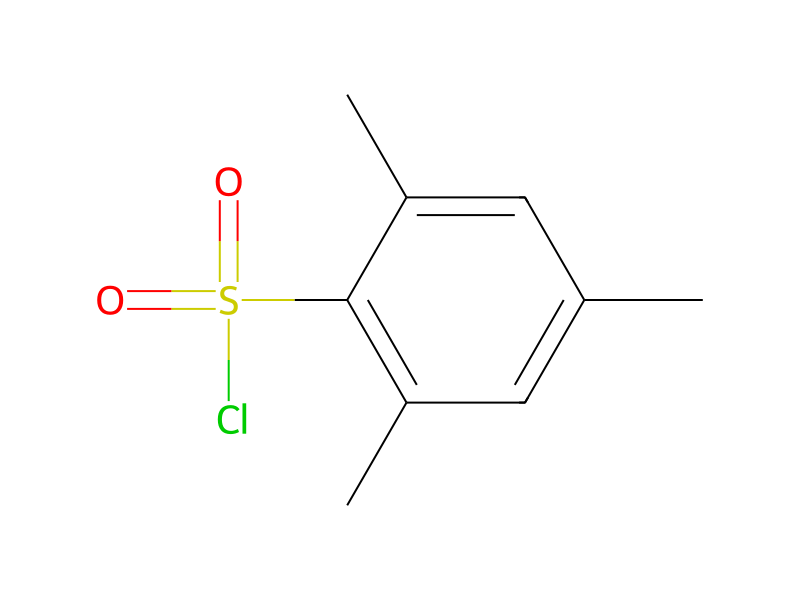
C(N(CC)CC)C.[OH:8][CH2:9][CH2:10][NH:11][C:12](=[O:18])[O:13][C:14]([CH3:17])([CH3:16])[CH3:15].Cl.CN(C)C.[C:24]1([CH3:36])[CH:29]=[C:28]([CH3:30])[CH:27]=[C:26]([CH3:31])[C:25]=1[S:32](Cl)(=[O:34])=[O:33]>ClCCl.O>[CH3:36][C:24]1[CH:29]=[C:28]([CH3:30])[CH:27]=[C:26]([CH3:31])[C:25]=1[S:32]([O:8][CH2:9][CH2:10][NH:11][C:12]([O:13][C:14]([CH3:15])([CH3:17])[CH3:16])=[O:18])(=[O:33])=[O:34]Participants
Reactant 4



Product 1

Reagents, catalysts & solvents 2


Conditions
- Temperature
- -10 °C
Procedure
Triethylamine (65 mL, 465.3 mmole, 1.5 eq) was added in one portion to a solution of tert-butyl N-(2-hydroxyethyl)carbamate (50.11 g, 310.2 mmole, 1.0 eq.) in dichloromethane (250 mL, 5 vols). The solution was cooled to −10° C. and trimethylamine hydrochloride (14.84 g, 155.1 mmole, 0.5 eq.) was added in one portion. The resultant mixture was cooled further to −15° C., stirred for 5 minutes, then treated with a solution of mesitylenesulfonyl chloride (74.74 g, 341.2 mmole, 1.1 eq) in dichloromethane (250 mL, 5 vols), over 28 minutes such that the internal temperature remained below −10° C. Once the addition was complete a precipitate had formed and the mixture was stirred at −10° C. for a further 30 minutes. Water (400 mL, 8 vols) was added and all of the precipitate dissolved. The mixture was stirred rapidly for 5 minutes, and then the two layers were separated. A solvent swap from dichloromethane to IPA was carried out by distillation at reduced pressure. Solvent was removed (450 mL) and replaced with IPA (450 mL) (initial pressure was 450 mbar, b.p. 24° C.; final pressure was 110 mbar, b.p. 36° C.). At the end of the distillation, solvent (150 mL) was removed to bring the volume down to 350 mL (7 vols with respect to the amount of tert-butyl N-(2-hydroxyethyl)carbamate used). The solution was cooled to 25° C., then water (175 mL) was added slowly with stirring, causing the solution gradually to turn cloudy. No solid had precipitated at this stage. More water (125 mL) was added, and a solid precipitate started to form after about 75 mL had been added. The internal temperature rose from 25° C. to 31° C. The mixture was stirred slowly and cooled to 7° C. The solid was collected by filtration, washed with IPA:water (1:1, 150 mL) and dried in vacuo at 40° C. for 21 hours to give the title compound as a white crystalline solid (92.54 g, 87%).
Workup
- customremained below −10° C
- additionOnce the addition
- customhad formed
- stirringthe mixture was stirred at −10° C. for a further 30 minutes
- dissolutionall of the precipitate dissolved
- stirringThe mixture was stirred rapidly for 5 minutes
- customthe two layers were separated
- distillationA solvent swap from dichloromethane to IPA was carried out by distillation at reduced pressure
- customSolvent was removed (450 mL)
- distillationAt the end of the distillation, solvent (150 mL)
- customwas removed
- temperatureThe solution was cooled to 25° C.
- additionwater (175 mL) was added slowly
- stirringwith stirring
- customNo solid had precipitated at this stage
- additionMore water (125 mL) was added
- customto form after about 75 mL
- additionhad been added
- customrose from 25° C. to 31° C
- stirringThe mixture was stirred slowly
- temperaturecooled to 7° C
- filtrationThe solid was collected by filtration
- washwashed with IPA:water (1:1, 150 mL)
- customdried in vacuo at 40° C. for 21 hours
Sources & evidence
- ORD record
- ord-839c1267f50241a4b45324cb2a370fe6
- Source dataset
- uspto-grants-2008_01
- Patent number
- US07314931B2
Reaction notes
Loading…